Φωτογραφικό Υλικό





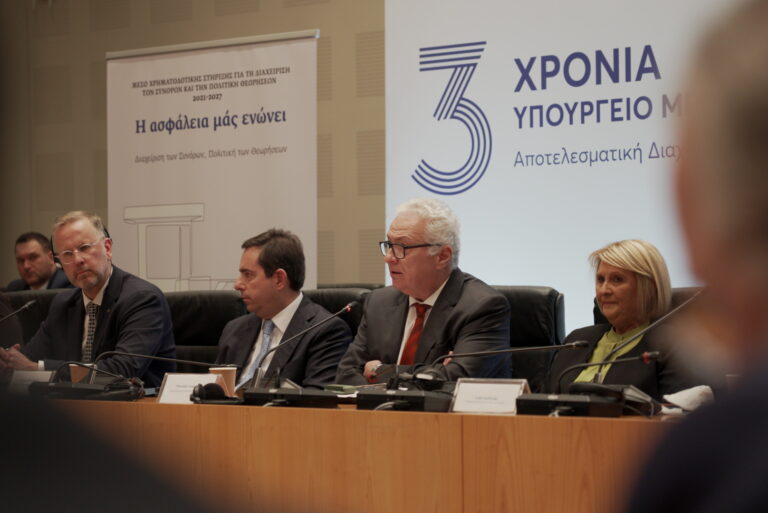
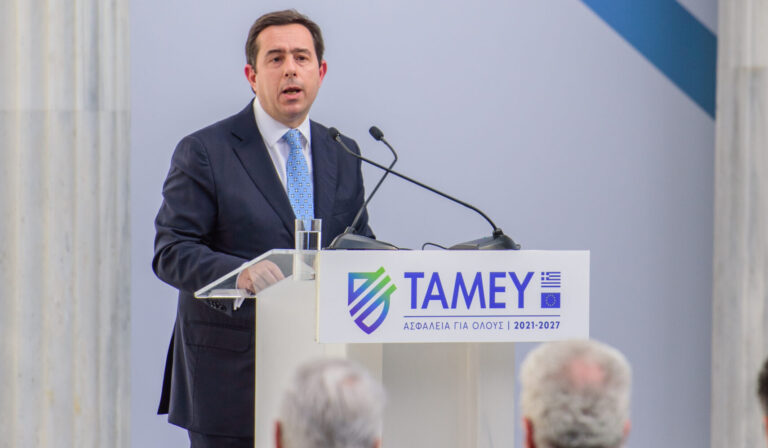

Πρόσκληση

Απολογιστικό Βίντεο Εκδήλωσης
Βίντεο εκδήλωσης (Live-streaming)
GR (Ελληνικά)
EN (Αγγλικά)
1. Programme strategy: main challenges and policy responses
Reference: points (a)(iii), (iv), (v) and (ix) Article 22(3) of Regulation (EU) 2021/1060 (CPR)
Baseline Situation
Situated at the crossroads of Europe, Asia and Africa, Greece is attractive to organized crime groups, especially regarding trafficking of human beings (THB) and drug crime. Global organized crime groups operate their trafficking networks in Greece, engaging in large-scale theft and financial crime. Criminal networks are also developing anti-forensics techniques such as cutting edge encryption technologies, complex algorithmic locking of data in any kind of media devices, multi layer and hidden storage volumes, aimed at restricting access of Law Enforcement Agencies (LEA) to critical information, misleading their forensic examinations by utilized falsified data.
SO1: Exchange of information
Challenges/Needs
Relevant Data [from Hellenic Police (HP) – National Centre for Social Solidarity (NCSS)]
Cybercrime
THB
Child Sexual Abuse (CSA)
Drug trafficking
Lessons Learnt
Administrative Capacity
National Strategy
Main Actions
SO2: Cross-border Cooperation
Challenges/Needs
Relevant Data [from HP]
Drug trafficking
National Strategy
Main actions
SO3: Preventing and combating crime
Challenges/Needs
Relevant Data [from HP, NCSS]
Cybercrime
Out of 6,019 cases reported, over 34% are related to fraudulent e-commerce services. The most important increases were: (i) on fraudulent transactions by 130% (2,055 cases in 2020, 891 in 2016), (ii) on threats regarding personal information by 95% (983 cases in 2021, 503 in 2016), and (iii) on data breaches/ illegal entry in IT systems by 180% (142 cases in 2016, 399 in 2021).
THB
Reported victims of human trafficking:
2019: 154, 2020: 167, 2021: 157.Currently there are 271 ongoing cases and an equal number of human trafficking victims receive protection services in the country.
Sexual exploitation was the most common form of abuse (64%), followed by human trafficking for the purpose of labor exploitation (19% – increased by 20% compared to 2018).
Fraud, Money Laundering, Illegal access to computer systems & phising (cases per year):
2020: 2490, 2019: 2051, 2018: 1761, 2017: 1332, 2016: 1125, 2015: 158.
National Strategy
Main Actions
Synergies and complementarities:
National Budget (NB):
2014-2020 Internal Security Fund- Police:
RRF:
HORIZON:
Other CPR Funds:
EUROPOL:
EMPACT:
Shortcomings to EU Acquis
The relevant EU acquis is already implemented. The current legal framework in Greece allows for the immediate implementation of the proposed actions in compliance with the EU acquis.
The new Sch-eval started at November 2021 and there are no official recommendations so far. The new Sch-Eval Recommendations finalized on July2022 and the respective action plan will be finalized in October 2022. On the 4th follow-up report, there were the following recommendations (rec):
The 21-27 ISF programme will cover future recommendations of Sch-eval and of the upcoming Police Cooperation Code.
2. Specific Objectives & Technical Assistance Reference: Article 22(2) and (4) CPR
|
Selected |
Specific objective or Technical assistance |
Type of action |
|
|
1. Exchange of information |
Regular actions |
|
|
1. Exchange of information |
Specific actions |
|
|
1. Exchange of information |
Annex IV actions |
|
|
1. Exchange of information |
Operating support |
|
|
1. Exchange of information |
Emergency assistance |
|
|
2. Cross-border cooperation |
Regular actions |
|
|
2. Cross-border cooperation |
Specific actions |
|
|
2. Cross-border cooperation |
Annex IV actions |
|
|
2. Cross-border cooperation |
Operating support |
|
|
2. Cross-border cooperation |
Emergency assistance |
|
|
3. Preventing and combating crime |
Regular actions |
|
|
3. Preventing and combating crime |
Specific actions |
|
|
3. Preventing and combating crime |
Annex IV actions |
|
|
3. Preventing and combating crime |
Operating support |
|
|
3. Preventing and combating crime |
Emergency assistance |
|
|
TA.36(5). Technical assistance – flat rate (Art. 36(5) CPR) |
|
|
|
TA.37. Technical assistance – not linked to costs (Art. 37 CPR) |
|
2.1.1. Description of the specific objective
Baseline Situation
The main beneficiary for the implementation of the following proposed actions is the Hellenic Police (HP). As a Law Enforcement Authority (LEA) with a specific strategy and certain vision, the HP will try to implement through these actions all the national and EU policies in the security sector. The rapid changes of the methods and tools used in cross-border and organized crime require even faster measures to be tackled in an effective way minimizing risks. This could be achieved through the collaboration among the competent Authorities to dismantle such organized crime groups.
Relevant Data (Hellenic Police)
Statistics related to searches performed on the existing AFIS system:
Regarding the operation of the Laboratory for Registration and Search of Genetic Types, the total of the registered genetic types during 2018-2020, is: 32,654 (2018); 37,405 (2019); 40,012 (2020).
Regarding the operation of the Laboratory of Analysis of Biological Materials of Atoms, there is an increase, both of the examined samples, and of the respective Laboratory Expertise Reports that are prepared, which is expected to become more intense in the coming years. A statistic depiction of 2018-2020 is the following:
Indicatively, statistics of photo display cases at the national level in 2017-2019 are given as follows: 3,993 (2017); 3,423(2018); 3,582(2019).
The aforementioned data show the constant need for collaboration in the field of Forensics and, therefore, new actions have been proposed in order to enhance and upgrade the systems and the information exchanged, as described in the implementation measures.
The impact is particularly felt in the light of the increased migration and refugee flows and the observed technological developments in the compilation of forged documents and values that characterize the current situation at the national and European level. In the ongoing laboratory examinations on documents (travel, etc.), which during the years 2017- 2019 have exceeded, in terms of documents, 7,000 cases (with > 27,000 pieces of evidence) while in terms of values characteristic is the ranking of our country (i.e. based on the examinations conducted) compared with the 28 EU-MSs, in 8th, 10th & 9th place (proof banknotes) and in 7th, 5th & 2nd place (proof coins).
Specific Challenges & Needs
Continuity and changes compared to the current funding period / Lessons Learnt:
Remedial Actions
Implementation Measures – Annex II par.1 (a)
Indicative types of Actions [ANNEX III: (a), (h)]
Annex II par.1 (b)
Annex II par.1 (c)
Annex II par.1 (d)
Through the above actions and specifically through the setting-up and upgrading of EU information systems, Greece is aiming to maintain a certain high security level by ensuring interoperability with IT systems of other MS on cross-border crime and information exchange with the use of the appropriate tools.
Desired outcomes and expected results
Consultation carried out with EU agencies
No consultation was performed with any EU agency on the implementation of the programme, as the actions described under this SO do not deviate significantly from the ones described under 2014-2020 ISF-Police NP .
The planned use of financial instruments
The actions described under this SO will be implemented by direct award grants to state bodies, to be implemented through public procurements, as the main beneficiaries of the Programme are Public Agencies.
No actions will be funded under SO1 operating support.
2.1.2. Indicators
Reference: point (e) of Article 22(4) CPR
|
ID |
Indicator |
Measurement unit |
Milestone (2024) |
Target (2029) |
|
O.1.1 |
Number of participants in training activities |
number |
45 |
174 |
|
O.1.2 |
Number of expert meetings/workshops/study visits |
number |
25 |
25 |
|
O.1.3 |
Number of ICT systems set up/adapted/maintained |
number |
285 |
901 |
|
O.1.4 |
Number of equipment items purchased |
number |
91 |
447 |
2.1.2. Indicators
Reference: point (e) of Article 22(4) CPR
|
ID |
Indicator |
Measurement unit |
Baseline |
Measurement unit for baseline |
Reference year(s) |
Target (2029) |
Measurement unit for target |
Source of data |
Comments |
|
R.1.5 |
Number of ICT systems made interoperable in the Member States/ with security- relevant EU and decentralised information systems/with international databases |
number |
0 |
number |
2021 |
566 |
number |
Hellenic Police (ISF-P NP 2014-2020: MIS 5003277&ISF-P NP 2014-2020: MIS 5008889) Institute of Child Health (ICH) & Ministry of Citizen Protection |
|
|
R.1.6 |
Number of administrative units that have set up new or adapted existing information exchange mechanisms/procedures/tools/guidance for exchange of information with other Member States/EU agencies/international organisations/third countries |
number |
0 |
number |
2021 |
1 |
number |
Institute of Child Health (ICH) & Ministry of Citizen Protection |
|
|
R.1.7 |
Number of participants who consider the training useful for their work |
number |
0 |
share |
2021 |
80 |
number |
Hellenic Police |
|
|
R.1.8 |
Number of participants who report three months after the training activity that they are using the skills and competences acquired during the training |
number |
0 |
share |
2021 |
64 |
number |
Hellenic Police |
|
2.1.3. Indicative breakdown of the programme resources (EU) by type of intervention
Reference: Article 22(5) CPR; and Article 16(12) AMIF Regulation, Article 13(12) ISF Regulation or Article 13(18) BMVI Regulation
|
Type of intervention |
Code |
Indicative amount (Euro) |
|
Type of action |
001.ICT systems, interoperability, data quality (excluding equipment) |
16,768,108.38 |
|
Type of action |
002.Networks, centres of excellence, cooperation structures, joint actions and operations |
999,762.00 |
|
Type of action |
003.Joint Investigation Teams (JITs) or other joint operations |
0.00 |
|
Type of action |
004.Secondment or deployment of experts |
0.00 |
|
Type of action |
005.Training |
372,660.00 |
|
Type of action |
006.Exchange of best practices, workshops, conferences, events, awareness-raising campaigns, communication activities |
0.00 |
|
Type of action |
007.Studies, pilot projects, risk assessments |
0.00 |
|
Type of action |
008.Equipment |
1,741,779.00 |
|
Type of action |
009.Means of transport |
0.00 |
|
Type of action |
010.Buildings, facilities |
187,500.00 |
|
Type of action |
011.Deployment or other follow-up of research projects |
0.00 |
2.1.1. Description of the specific objective
Baseline Situation
The increased operational cooperation actions described in section 1, build upon the actions presented in S.O.1 and work in correlation to each other. The actions presented here belong in different thematic categories that also work together to provide the optimal result with the available resources for the potential beneficiaries under this S.O. The main LEAs under SO2 is the HP.
Relevant Data [from HP]
Drugs
The Directorate for Drug Prosecution receives many European Investigation Orders, through which various MSs (e.g., Spain, Belgium, Sweden, Germany, Italy and the Netherlands) are constantly requesting specific information on members and activities of criminal organisations and networks, controls of bank accounts and financial transactions of suspects or defendants, covert investigations and even telecommunications surveillance. At the same time, the HP undertakes many operational collaborations in cooperation with other MSs and third countries. For this reason, it sets up JITs with one or more MSs, such as France and Germany, as well as with neighbouring third countries under EMPACT OA. Τhe cooperation with third countries will not occur on a daily bases but only when there is a need for cooperation according to the operational practices used so far and after the approval by COM.
The number of drug seizure cases carried out by the Greek Prosecution Authorities in 2019 was 13,595, remaining at the same levels compared to 2018 (+0.5%). These cases include those that were formed mainly for possession or use of drugs and secondarily for trafficking. Indicatively, it is stated that the cases in which “significant” quantities of drugs were seized, according to the categorisation used by the United Nations Office on Drugs and Crime (UNODC) 1 –i.e., categorisation applied to cases of mainly drug trafficking– correspond to 5,5% of the total. However, it is noted that in a limited number of cases, while the offense of trafficking was established, the seized quantities were less than the corresponding limits set by the UNODC. The number of defendants in the year 2019 was 18,297, remaining at the same levels compared to the year 2018 (-0.02%).
The total estimated “commercial” value of the seized quantities of drugs exceeded €1,13 billion.
The total amount of cocaine seized in Greece in 2019 was 953,422 kg, representing an increase of 474.8% compared to 2018.
Specific Challenges & Needs
Results achieved under the 2014-2020 MFF:
Implementation Measures
Indicative types of actions
Annex II: par.2 (a), ANNEX III (k),
Actions with MS (e.g. Spain, Belgium, Sweden, Germany, Italy and the Netherlands) to prevent and combat drug trafficking through the procurement of relevant operational equipment which will be used in cross-border operations to obtain more information on criminal organisations in the fields of drug trafficking and perform more joint patrols and arrests. The requested equipment will be used in joint actions in EU, non-EU border such as Hellenic-Albanian, Hellenic-Turkish borders. Specifically, the cross-border actions will target Open Geospatial Consortiums (OCGs) and facilitators involved in wholesale trafficking of drugs via EU borders through Greece and the Balkan region into the EU. Also, through the actions other serious forms of criminality perpetrated by the OCGs will be appropriately pursued. Specific activities:
Annex III: (k)
Annex II par.2 (b)
Desired outcomes and expected results
No actions will be funded under SO2 operating support.
2.1.2. Indicators
Reference: point (e) of Article 22(4) CPR
|
ID |
Indicator |
Measurement unit |
Milestone (2024) |
Target (2029) |
|
O.2.1 |
Number of cross-border operations |
number |
0 |
12 |
|
O.2.1.1 |
Of which number of joint investigation teams |
number |
0 |
0 |
|
O.2.1.2 |
Of which number of EU policy cycle/EMPACT operational actions |
number |
0 |
0 |
|
O.2.2 |
Number of expert meetings/workshops/study visits/common exercises |
number |
0 |
0 |
|
O.2.3 |
Number of equipment items purchased |
number |
7 |
36 |
|
O.2.4 |
Number of transport means purchased for cross-border operations |
number |
0 |
3 |
2.1.2. Indicators
Reference: point (e) of Article 22(4) CPR
|
ID |
Indicator |
Measurement unit |
Baseline |
Measurement unit for baseline |
Reference year(s) |
Target (2029) |
Measurement unit for target |
Source of data |
Comments |
|
R.2.5 |
The estimated value of assets frozen in the context of cross-border operations |
amount |
0 |
euro |
2021 |
1,400,000 |
amount |
Hellenic Police |
|
|
R.2.6.1 |
Quantity of illicit drugs seized in the context of cross-border operations – cannabis |
kg |
0 |
kg |
2021 |
15,000 |
kg |
Hellenic Police |
|
|
R.2.6.2 |
Quantity of illicit drugs seized in the context of cross-border operations – opioids, including heroin |
kg |
0 |
kg |
2021 |
0 |
kg |
N/A |
|
|
R.2.6.3 |
Quantity of illicit drugs seized in the context of cross-border operations – cocaine |
kg |
0 |
kg |
2021 |
0 |
kg |
N/A |
|
|
R.2.6.4 |
Quantity of illicit drugs seized in the context of cross-border operations – synthetic drugs, including amphetamine-type stimulants (including amphetamine and methamphetamine) and MDMA |
kg |
0 |
kg |
2021 |
0 |
kg |
N/A |
|
|
R.2.6.5 |
Quantity of illicit drugs seized in the context of cross-border operations – new psychoactive substances |
kg |
0 |
kg |
2021 |
0 |
kg |
N/A |
|
|
R.2.6.6 |
Quantity of illicit drugs seized in the context of cross-border operations – other illicit drugs |
kg |
0 |
kg |
2021 |
0 |
kg |
N/A |
|
|
R.2.7.1 |
Quantity of weapons seized in the context of cross-border operations – Weapons of war: automatic firearms and heavy firearms (anti-tank, rocket launcher, mortar, etc.) |
number |
0 |
number |
2021 |
0 |
number |
N/A |
|
|
R.2.7.2 |
Quantity of weapons seized in the context of cross-border operations – Other short firearms: revolvers and pistols (including salute and acoustic weapons) |
number |
0 |
number |
2021 |
40 |
number |
Hellenic Police |
|
|
R.2.7.3 |
Quantity of weapons seized in the context of cross-border operations – Other long firearms: rifles and shotguns (including salute and acoustic weapons) |
number |
0 |
number |
2021 |
0 |
number |
N/A |
|
|
R.2.8 |
Number of administrative units that have developed/adapted existing mechanisms/procedures/ tools/guidance for cooperation with other Member States/EU agencies/international organisations/third countries |
number |
0 |
number |
2021 |
0 |
number |
N/A |
|
|
R.2.9 |
Number of staff involved in cross-border operations |
number |
0 |
number |
2021 |
0 |
number |
N/A |
|
|
R.2.10 |
Number of Schengen Evaluation Recommendations addressed |
number |
0 |
number |
2021 |
100 |
percentage |
Hellenic Police |
|
2.1.3. Indicative breakdown of the programme resources (EU) by type of intervention
Reference: Article 22(5) CPR; and Article 16(12) AMIF Regulation, Article 13(12) ISF Regulation or Article 13(18) BMVI Regulation
|
Type of intervention |
Code |
Indicative amount (Euro) |
|
Type of action |
001.ICT systems, interoperability, data quality (excluding equipment) |
0.00 |
|
Type of action |
002.Networks, centres of excellence, cooperation structures, joint actions and operations |
0.00 |
|
Type of action |
003.Joint Investigation Teams (JITs) or other joint operations |
0.00 |
|
Type of action |
004.Secondment or deployment of experts |
0.00 |
|
Type of action |
005.Training |
0.00 |
|
Type of action |
006.Exchange of best practices, workshops, conferences, events, awareness-raising campaigns, communication activities |
0.00 |
|
Type of action |
007.Studies, pilot projects, risk assessments |
0.00 |
|
Type of action |
008.Equipment |
3,849,750.00 |
|
Type of action |
009.Means of transport |
582,000.00 |
|
Type of action |
010.Buildings, facilities |
37,500.00 |
|
Type of action |
011.Deployment or other follow-up of research projects |
0.00 |
2.1.1. Description of the specific objective
Baseline Situation
Terrorism
Through a series of actions and initiatives implemented since 2016, CSS contributes to the strengthening of front-line professionals for better ‘Understanding’, ‘Recognition’ and ‘Management’ of the risks of Radicalisation leading to violent extremism and terrorism. By the end of 2019, about half of the 5,000 European fighters who had travelled to Islamic State-held areas had returned.
Relevant Data [ from HP, CSS, HCG and NCSS]
From 2019-2021, the Directorate of Special Violence Crimes (DSVC) has been involved in incidents concerning terrorism and radicalisation: Incidents: 2 (2019); 6 (2020); 0 (2021, 1st semester), Arrests: 5 (2019); 14 (2020); 1 (2021, 1st semester)
During the same period, more than 600 (649) staff attended the seminars concerning the protection of infrastructures and more than 400 (453) attended the trainings.
Organized Crime
Criminal organisations mainly use vehicles with forged Vehicle Identification Number (VINs) and Engine Numbers for crimes such as THB and drug trafficking. The confiscated vehicles through the on-the-spot examination of the electronics provide useful information on the criminal organisations both at national and EU level.
Trafficking in Human Beings
In 2019, 154 cases of victims of THB were reported. In particular, Public Agencies sent reports concerning 68 victims and NGOs and International Organizations (IOs) 86 victims. In 2020, reports were sent for 167 victims of THB (Public Agencies 45; NGOs and IOs 122). During the first half of 2021, 73 reports on new cases were sent (Public Agencies 29; NGOs and IOs 44).
CSA
According to the latest available data, between 2017 and 2018, more than 14,000 victims of ΤΗΒ were recorded within EU. The actual number may be much higher, as many victims are not identified. In Greece, 34% of the victims of THB during the period ranging from 01/2019 to 01/2022 were children, with the predominant form of exploitation being begging as well as recorded cases of sexual exploitation and forced crime. Children remain one of the most vulnerable trafficking groups worldwide and in our country as, 158 of the 478 reported victims of trafficking in Greece are children, some of whom are unaccompanied. Most of adult victims are under the age of 35.
One in five children in Europe is a victim of sexual abuse, while in Greece the quota is 16%. Internationally, online child abuse is on the rise and became more widespread during the pandemic, when travel restrictions prevented perpetrators from abusing children for life.
Cases of Child Sexual Abuse (CSA) that were reported to the hotline specifically dedicated for the afor mentioned perpose (serves as the main communication number with the CYBERALERT center of DIDHE):
2020: 300 (76 victims were identified/ 27% were under 15 years old/ 89,48% were female/ 2,6% of the perpetrators were minors, while 95% of the perpetrators were male), 2019: 329, 2018: 282
Cybercrime
Criminal organisations are using the internet and new technologies, as they facilitate their criminal activities, and they assist them to find potential victims. Anonymity and easy access to illegal services and goods offered by the “Dark Web” have created new criminal activities and methods. The HP has received many calls in 2019 and 2020 on such matters. In 2019 the total calls to the Call Centre were 108,163 and in 2020 127,366, i.e. an increase of 17.75% compared to the previous year.
Drugs
The laboratories of Forensic Science Division (DEE) are facing a constant rise in the cases that include the use of synthetic drugs that affect the sampling process, in general. The number of laboratory procedures carried out per year is approximately 3,000 covering only certain categories of addictive substances.
Economic & Financial Crime
Several cases were reported either separately or in combination with the insurance and labour law and fraud at national and EU level, concerning corruption and money laundering that need to be monitored promptly. During 2017, 2018 and 2019, 2,624 cases were handled by the Departments of the Financial Police Division (D.F.P.D.) and of Financial Police Sub-Division of Northern Greece (F.P.S.D.N.G), in cooperation with other Authorities.
Operational Equipment
Cases of examination of audiovisual material at the national level in the last three years are as follows:
The investigation of the recent terrorist attacks in EU required the evaluation, analysis and examination of digital data. When terrorist attacks involve the use of e.g. improvised explosive devices, it is crucial to determine the type of the explosives used and how they work. From 2017 to 2021 the competent laboratories dealt with 452 cases.
Corruption
National Transparency Authority has to acquire a strong international presence and a decisive contribution to the defense of the public interest, the restoration of citizens’ trust (National & EU level) in institutions and the development of equal opportunities for all.
During 2019, 628 complaints were submitted, while in 2020 there were 438, mainly due to new technologies and the new types of electronic transactionsin which there is a severe lack of familiarization by a significant percentage of the Greek public.
Specific Challenges & Needs
Results achieved under the 2014-2020 MFF:
Implementation Measures
Annex II par.3 (a)
Indicative types of actions
Annex II par.3 (c)
Annex II par.3 (d)
Annex II par.3 (e)
All the above trainings will be in-line with the training priorities and core capability gaps identified in the EU-STNA 2022-2025. Moreover considering that all training activities will occur in coordination with CEPOL, with a view to avoiding duplication and enhancing synergies
The beneficiaries will use all the assets and tools linked to EU-funded civil security research and innovation, either in the planning process or in the phase of drafting the technical specifications for the above ICT projects. As regards the selection of best procurement implementation method per project, the beneficiaries may use iProcureNet Network for Joint cross-border procurement.
Desired outcomes and expected results
Consultation carried out with EU agencies
All training activities will occur in coordination with CEPOL, with a view to avoiding duplication and enhancing synergies on the implementation of the NP.
The planned use of financial instruments
The actions described under this SO will be implemented by direct award grants to state bodies, to be implemented through public procurements, as the main beneficiaries of the Programme are Public Agencies.
Operating Support for SO3
The beneficiaries of the operating support are Hellenic Police first responders (two-wheeled policing) who contribute to the prevention and combating of crimes which are not restricted to national level but concern cross-border serious and organized crimes. The actions proposed are fully in line with Annex VII 3 (b) of the ISF Regulation.
2.1.2. Indicators
Reference: point (e) of Article 22(4) CPR
|
ID |
Indicator |
Measurement unit |
Milestone (2024) |
Target (2029) |
|
O.3.1 |
Number of participants in training activities |
number |
1,267 |
3,729 |
|
O.3.2 |
Number of exchange programmes/workshops/study visits |
number |
57 |
197 |
|
O.3.3 |
Number of equipment items purchased |
number |
580 |
5,604 |
|
O.3.4 |
Number of transport means purchased |
number |
0 |
2 |
|
O.3.5 |
Number of items of infrastructure/security relevant facilities/tools/mechanisms constructed/ purchased/upgraded |
number |
5 |
31 |
|
O.3.6 |
Number of projects to prevent crime |
number |
0 |
1 |
|
O.3.7 |
Number of projects to assist victims of crime |
number |
0 |
4 |
|
O.3.8 |
Number of victims of crimes assisted |
number |
0 |
300 |
2.1.2. Indicators
Reference: point (e) of Article 22(4) CPR
|
ID |
Indicator |
Measurement unit |
Baseline |
Measurement unit for baseline |
Reference year(s) |
Target (2029) |
Measurement unit for target |
Source of data |
Comments |
|
R.3.9 |
Number of initiatives developed / expanded to prevent radicalisation |
number |
0 |
number |
2021 |
21 |
number |
Hellenic Police |
|
|
R.3.10 |
Number of initiatives developed / expanded to protect / support witnesses and whistle- blowers |
number |
0 |
number |
2021 |
41 |
number |
Hellenic Police |
|
|
R.3.11 |
Number of critical infrastructure/public spaces with new/adapted facilities protecting against security related risks |
number |
0 |
number |
2021 |
585 |
number |
Hellenic Police |
|
|
R.3.12 |
Number of participants who consider the training useful for their work |
number |
0 |
share |
2021 |
2,203 |
number |
Hellenic Police |
|
|
R.3.13 |
Number of participants who report three months after leaving the training that they are using the skills and competences acquired during the training |
number |
0 |
share |
2021 |
550 |
number |
Hellenic Police |
|
2.1.3. Indicative breakdown of the programme resources (EU) by type of intervention
Reference: Article 22(5) CPR; and Article 16(12) AMIF Regulation, Article 13(12) ISF Regulation or Article 13(18) BMVI Regulation
|
Type of intervention |
Code |
Indicative amount (Euro) |
|
Type of action |
001.ICT systems, interoperability, data quality (excluding equipment) |
1,596,866.70 |
|
Type of action |
002.Networks, centres of excellence, cooperation structures, joint actions and operations |
223,698.00 |
|
Type of action |
003.Joint Investigation Teams (JITs) or other joint operations |
0.00 |
|
Type of action |
004.Secondment or deployment of experts |
3,923,478.71 |
|
Type of action |
005.Training |
1,432,050.00 |
|
Type of action |
006.Exchange of best practices, workshops, conferences, events, awareness-raising campaigns, communication activities |
2,012,360.55 |
|
Type of action |
007.Studies, pilot projects, risk assessments |
0.00 |
|
Type of action |
008.Equipment |
5,900,687.42 |
|
Type of action |
009.Means of transport |
1,783,443.14 |
|
Type of action |
010.Buildings, facilities |
137,850.00 |
|
Type of action |
011.Deployment or other follow-up of research projects |
0.00 |
2.2. Technical assistance: TA.36(5). Technical assistance – flat rate (Art. 36(5) CPR)
Reference: point (f) of Article 22(3), Article 36(5), Article 37, and Article 95 CPR
|
Technical and legal assistance will be provided for the implementation of the new regulations and obligations for Greece derived from them in order the new IT systems and relevant processes to be better implemented, as well as ongoing technical support throughout the programmed actions to be provided. Additionally, the technical assistance addresses the need to adjust to national legislation in terms of security, data protection and fundamental rights. Such assistance includes the provision of advice, expertise, research, analysis, training or other assistance in connection with, inter alia:
Current technical assistance programmes are undertaken in accordance with the mandate of each respective department, office, agency, fund or programme and within the existing financial resources allocated for such purposes under their respective programme budgets. Allocation of Technical Assistance and indicative Actions Information & Communication (allocation: 10%)
Preparation, implementation, monitoring and control (allocation 20%)
Evaluation and studies, data collection (allocation 10%)
Capacity building (allocation 60%)
|
2.2.2. Indicative breakdown of technical assistance pursuant to Article 37 CPR
|
Type of intervention |
Code |
Indicative amount (Euro) |
|
Intervention field |
034.Information and communication |
249,296.96 |
|
Intervention field |
035.Preparation, implementation, monitoring and control |
498,593.93 |
|
Intervention field |
036.Evaluation and studies, data collection |
249,296.96 |
|
Intervention field |
037.Capacity building |
1,495,781.78 |
3. Financing plan
Reference: point (g) Article 22(3) CPR
|
Allocation type |
2021 |
2022 |
2023 |
2024 |
2025 |
2026 |
2027 |
Total |
|
Initial allocation |
|
5,892,991.00 |
8,820,173.00 |
8,606,745.00 |
7,418,820.00 |
6,310,588.00 |
5,721,782.00 |
42,771,099.00 |
|
Mid-term review |
|
|
|
|
|
|
|
|
|
Thematic facility WPI |
|
1,271,364.53 |
|
|
|
|
|
1,271,364.53 |
|
Thematic facility WPII |
|
|
|
|
|
|
|
|
|
Thematic facility WPIII |
|
|
|
|
|
|
|
|
|
Transfer (in) |
|
|
|
|
|
|
|
|
|
Transfer (out) |
|
|
|
|
|
|
|
|
|
Total |
|
7,164,355.53 |
8,820,173.00 |
8,606,745.00 |
7,418,820.00 |
6,310,588.00 |
5,721,782.00 |
44,042,463.53 |
3.2. Total financial allocations
|
Specific objective (SO) |
Type of action |
Basis for calculation Union support (total or public) |
Union contribution (a) |
National contribution (b)=(c)+(d) |
Indicative breakdown of national contribution |
Total (e)=(a)+(b) |
Co-financing rate (f)=(a)/(e) |
|
|
Public (c) |
Private (d) |
|||||||
|
Exchange of information |
Regular actions |
Total |
19,205,809.38 |
6,401,936.46 |
6,401,936.46 |
|
25,607,745.84 |
75.0000000000% |
|
Exchange of information |
Specific actions |
Total |
864,000.00 |
96,000.00 |
96,000.00 |
|
960,000.00 |
90.0000000000% |
|
Exchange of information |
Annex IV actions |
Total |
0.00 |
0.00 |
0.00 |
|
0.00 |
|
|
Exchange of information |
Operating support |
Total |
0.00 |
0.00 |
0.00 |
|
0.00 |
|
|
Total Exchange of information |
|
|
20,069,809.38 |
6,497,936.46 |
6,497,936.46 |
|
26,567,745.84 |
75.5420106051% |
|
Cross-border cooperation |
Regular actions |
Total |
4,469,250.00 |
1,489,750.00 |
1,489,750.00 |
|
5,959,000.00 |
75.0000000000% |
|
Cross-border cooperation |
Annex IV actions |
Total |
0.00 |
0.00 |
0.00 |
|
0.00 |
|
|
Cross-border cooperation |
Operating support |
Total |
0.00 |
0.00 |
0.00 |
|
0.00 |
|
|
Total Cross-border cooperation |
|
|
4,469,250.00 |
1,489,750.00 |
1,489,750.00 |
|
5,959,000.00 |
75.0000000000% |
|
Preventing and combating crime |
Regular actions |
Total |
12,751,555.31 |
4,250,518.44 |
4,250,518.44 |
|
17,002,073.75 |
74.9999999853% |
|
Preventing and combating crime |
Specific actions |
Total |
335,400.50 |
37,266.73 |
37,266.73 |
|
372,667.23 |
89.9999981216% |
|
Preventing and combating crime |
Annex IV actions |
Total |
0.00 |
0.00 |
0.00 |
|
0.00 |
|
|
Preventing and combating crime |
Operating support |
Total |
3,923,478.71 |
1,307,826.24 |
1,307,826.24 |
|
5,231,304.95 |
74.9999999522% |
|
Total Preventing and combating crime |
|
|
17,010,434.52 |
5,595,611.41 |
5,595,611.41 |
|
22,606,045.93 |
75.2472793016% |
|
Technical assistance – flat rate (Art. 36(5) CPR) |
|
|
2,492,969.63 |
|
|
|
2,492,969.63 |
100.0000000000% |
|
Grand total |
|
|
44,042,463.53 |
13,583,297.87 |
13,583,297.87 |
|
57,625,761.40 |
76.4284279461% |
3.3. Transfers
|
Transferring fund |
Receiving fund |
||||||
|
AMIF |
BMVI |
ERDF |
ESF+ |
CF |
EMFAF |
Total |
|
|
ISF |
|
|
|
|
|
|
|
1Cumulative amounts for all transfers during programming period.
|
Instrument |
Transfer Amount |
1Cumulative amounts for all transfers during programming period.
4. Enabling conditions
Reference: point (i) of Article 22(3) CPR
|
Enabling condition |
Fulfilment of enabling condition |
Criteria |
Fulfilment of criteria |
Reference to relevant documents |
Justification |
|
1. Effective monitoring mechanisms of the public procurement market |
Yes |
Monitoring mechanisms are in place that cover all public contracts and their procurement under the Funds in line with Union procurement legislation. That requirement includes: 1. Arrangements to ensure compilation of effective and reliable data on public procurement procedures above the Union thresholds in accordance with reporting obligations under Articles 83 and 84 of Directive 2014/24/EU and Articles 99 and 100 of Directive 2014/25/EU.
|
Yes |
• Law 4412/2016 (Articles 45, 277, 340, 341) • Joint Ministerial Decision 70362_24.06.2021 • Positive Opinion of Hellenic Single Public Procurement Authority |
Greece has transposed into Greek law the relevant provisions of the Directives and has taken the actions induced by them: In Article 340 of Law 4412/2016, Articles 83(1-5) of Directive 2014/24/EU and 99(1-5) of Directive 2014/25/EU are intergated, by appointing the Hellenic Single Public Procurement Authority (H.S.P.P.A.) as the competent body for monitoring the system, according to its competences. Furthermore, by delegation of the above Article 340, the Common Ministerial Decision no. 70362/24.06.2021 was issued, which determines the details for drafting the monitoring report for the implementation of public procurement rules (Government Gazette B’ 2802/30.06.2021, see also corrections in Government Gazette B’ 3488/30.07.2021). In Article 45 of Law 4412/2016, Articles 83(6) and 84(2) of Directive 2014/24/EU are incorporated. In article 277 of the same Law, paragraph 6 of Article 99(6) and 100(2) of Directive 2014/25/EU are integrated. In article 341 of Law 4412/2016, Articles 84(1), 84(3)of Directive 2014/24/EU and 100(1), 100(3) of Directive 2014/25/EU are incorporated. |
|
2. Arrangements to ensure the data cover at least the following elements: a. Quality and intensity of competition: names of winning bidder, number of initial bidders and contractual value; b. Information on final price after completion and on participation of SMEs as direct bidders, where national systems provide such information. |
Yes |
• Joint Ministerial Decision 76928/9-7-2021 |
The requested data can be retrieved from the following information systems: a) Central Electronic Public Procurement Registry (KIMDIS); b) Integrated Information System of the National System of Electronic Public Procurement (OPS ESIDIS) and c) Monitoring Information System of the National Strategic Reference Framework (OPS NSRF). For the retrieval of requested data, the competent departments of the Ministry of Development & Investments and the Ministry of Infrastructure & Transport as well as the Special Service of the Monitoring Information System of the NSRF cooperate. The details of the contractors are registered in KIMDIS in the registration tabs of award decisions, contracts and payments. The number of submitted bids is available in OPS ESIDIS. The value of the contract without VAT is included in every contract registered in KIMDIS. The final value of a contract is reflected in the value of the respective award decision and the contract which are registered in KIMDIS. There is no information available on the participation of small and medium-sized enterprises in the electronic public procurement systems. |
||
|
3. Arrangements to ensure monitoring and analysis of the data by the competent national authorities in accordance with article 83 (2) of directive 2014/24/EU and article 99 (2) of directive 2014/25/EU. |
Yes |
• Law 4412/2016 (Article 340) • Law 4013/2011 • Organization chart of Hellenic Single Public Procurement Authority |
Greece, in order to meet the requirements for monitoring the public procurement system, as set out in Articles 83(2) of Directive 2014/24/EU and 99(2) of Directive 2014/25/EU, has taken the following actions: • With Article 340 of Law 4412/2016, H.S.P.P.A. was appointed as the competent body for monitoring the system, according to its relevant competencies and responsibilities, as described in its Establishment Act (Law 4013/2016) and its Internal Rules of Operation (Government Gazette A’ 52/01.04.2019). • With the Common Ministerial Decision no. 70362/24.06.2021, published in Government Gazette B’ 2802/30.06.2021 and corrected in Government Gazette B’ 3488/30.07.2021, the details for the collection and analysis of data were determined. |
||
|
4. Arrangements to make the results of the analysis available to the public in accordance with article 83 (3) of directive 2014/24/EU and article 99 (3) directive 2014/25/EU. |
Yes |
• Monitoring Report of the Public Procurement System for 2017 (Hellenic Single Public Procurement Authority) • DG-GROW Country reports • Hellenic public procurement monitoring report for the period 2018 – 2020 • Monitoring Report of the Public Contract System for the period 2018-2020 (Hellenic Single Public Procurement Authority) • Announcements of Hellenic Single Public Procurement Authority |
The monitoring report of the public procurement system of article 340 of Law 4412/2016 is published on the website of H.S.P.P.A. as well as on the DG-GROW website, where all respective MS country reports are published: https://eaadhsy.gr/index.php/category-articles-eaadhsy/347-ek8esh-parakoloy8hshs-toy-systhmatos-twn-dhmosiwn-symvasewn-etoys-2017 and https://ec.europa.eu/growth/single-market/public-procurement/country-reports_en. Following publication of Common Ministerial Decision no. 70362/24.06.2021, co-signed by the Minister of Development and Investments and the Minister of Interior, published in Government Gazette B’ 2802/30.06.2021 and corrected in Government Gazette B’ 3488/30.07.2021, H.S.P.P.A. received the information provided by the liable entities and drafted the Public Procurement Monitoring Report for the period 2018-2020, which was approved by Decision No. 1ES/2022 of the Authority’s Council: https://eaadhsy.gr/index.php/category-articles-eaadhsy/671-ekthesi-parakolouthisis-tou-systimatos-ton-dimosion-symvaseon-periodou-2018-2020 |
||
|
5. Arrangements to ensure that all information pointing to suspected bid-rigging situations is communicated to the competent national bodies in accordance with Article 83(2) of Directive 2014/24/EU and Article 99(2) of Directive 2014/25/EU. |
Yes |
• Law 4412/16 (Ar. 340) • Law 3959/11 • MoU between Hellenic Single Public Procurement Authority (HSPPA) and Hellenic Competition Commission (HCC) • https://whistle2eaadhsy.disclosers.eu/#/ • https://www.epant.gr/en/whistleblowing.html • HSPPA Guidelines 20/17 & 9/15 • Corruption Risk Management Guide (National Transprarency Authority) • Guide for detecting and preventing collusion practices in procurement tenders (HCC) • Notice on tools to fight collusion in public procurement and on guidance on how to apply the related exclusion ground (2021/C 91/01) |
Greece, in order to ensure the proper management of cases of unfair competition or situations that distort or threaten to distort competition, has transposed into Greek Law the relevant provisions of Directives 2014/24/EU & 2014/25/EU. Said provisions were integrated through article 340 of Law 4412/16. Furthermore, HSPPA, as the competent Authority for monitoring the public procurement system cooperates closely for this purpose with the HCC, being the competent Authority for the protection of free and fair competition. It is pointed out that suspected cases of bid-rigging situations can be detected through: • The anonymous complaints “whistleblowing” of HSPPA and HCC, submitted directly or through designated platforms. • Random sampling In order to raise awareness of contracting authorities/contracting entities for the detection and management of such cases, the following documentation was issued: • Guidelines 20 and 9 of HSPPA • The National Transparency Authority’s Corruption and Fraud Risk Management Guide • The HCC Guide: “Detection and prevention of corruptive practices in public procurement procedures” (2014) |
||
|
3. Effective application and implementation of the Charter of Fundamental Rights |
Yes |
Effective mechanisms are in place to ensure compliance with the Charter of Fundamental Rights of the European Union (‘the Charter’) which include: 1. Arrangements to ensure compliance of the programmes supported by the Funds and their implementation with the relevant provisions of the Charter.
|
Yes |
• Law 4914/2022 on ‘Management, control and implementation of development interventions for the 2021-2027 programming period,…’. • Policy statement on respect for fundamental rights • Memorandum of Cooperation of HRC/EUCA • Law 4780/2021 “National Accessibility Authority, National Commission for Human Rights…” 2021-2027 HOME funds • Establishment of the Fundamental Rights Officer and of the Committee on the compliance with the Fundamental Rights in the Ministry of Migration |
The arrangements for compliance with the Charter cover all stages of the programme’s implementation i.e. partnership principle; management and control systems, roles and trainings of authorities/bodies; calls for proposals/tenders; evaluation, implementation and verifications of operations. A Task Force for Fundamental Rights Compliance (TFFRC) will be set-up within the Monitoring Committee to monitor the progress of the procedures followed at all stages. A Fundamental Rights Officer within the Ministry of Migration and Asylum will be a point of reference for compliance with the Charter. The National Transparency Authority (NTA) and the Ombudsman will investigate alleged breaches. The TFFRC will report to the Monitoring Committee at least once a year on complaints and cases of non-compliance. National authorities such as the NTA and the Ombudsman are clearly defined in the handling of complaints. The National Commission for Human Rights will provide support to all actors. |
|
2. Reporting arrangements to the monitoring committee regarding cases of non-compliance of operations supported by the Funds with the Charter and complaints regarding the Charter submitted in accordance with the arrangements made pursuant to Article 69(7). |
Yes |
• Procedure of “ΔVII_3 Reception and Examination of Complaints” in Chapter LV.VII, Management & Control System • Law 4443/2016 • Law 4622/2019 |
The TFFRC will oversee and report to the Monitoring Commitee at least once a year on complaints and cases of non compliance. National authroities such as the National Transparency Authority and the Ombudsman are clearly defined in the handling of complaints and the National Commission for Human Rights will provide support to all actors involved. |
||
|
4. Implementation and application of the United Nations Convention on the rights of persons with disabilities (UNCRPD) in accordance with Council Decision 2010/48/EC |
Yes |
A national framework to ensure implementation of the UNCRPD is in place that includes: 1. Objectives with measurable goals, data collection and monitoring mechanisms. |
Yes |
• UN Convention on the Rights of Persons with Disabilities, legislated by EU: 23/12/10 & by Greece: Law 4074/2012,11/04/12 • “Directorates – Organizational Provisions for the Implementation of the UN Convention on Rights of persons with Disabilities”, art. 59 – 74, Law 4488/2017, Nat.Gazette 137 – 13/09/17 • National Action Plan for the Rights of Persons with Disabilities (NAP) • Law 4780/21 “National Accessibility Authority” (Nat. Gazette 30A/28-02-21) • Digital portal for people with disabilities • ESAmeA Disability Observatory • National Commission for Human Rights (NCHR) |
• Law 4488/17 • 2020: NAP was completed following public consultation; Individual Reference Points were defined in Ministries, Regions, and Municipalities and activated for its monitoring • The NAP is a road map with a framework of actions especially for the period 2020-23 (however, it contains permanent actions with an implementation horizon until 2029) with 6 pillars and 30 objectives that is updated • Its implementation is monitored by the Coordinating Mechanism in the Government, the Minister of State and the GS of the Coordination of the Government, using the MIS for the Government: “MAZI”. The NAP compiles into a single strategic planning actions of Ministries and competent bodies that are broken down into individual projects with an implementation schedule, monitoring and evaluation indicators and those in charge of implementation • All bodies involved in the implementation of the NAP consult with the National Confederation of Disabled People and its members. The results of the monitoring and evaluation are made available annually to the public, while consultation actions on the course of the implementation of the NAP are supported. |
|
2. Arrangements to ensure that accessibility policy, legislation and standards are properly reflected in the preparation and implementation of the programmes. |
Yes |
• Planning NSRF & other Programmes 2021-2027 • Programme Consultations • Law 4914/2022 on the “Management, control and implementation of development interventions for the Programming Period 2021-2024” • Communication guide 2021-2027 • Policy Statement on respect for the UN Convention on Persons with Disabilities • Law 4780/2021 “National Accessibility Authority” • Digital portal for Persons with Disabilities (PWD)/legislation • Working Group for PWD • PWD: joint action to strengthen the institutional capacity and development of the PWD Observatory
|
The NAP Coordination Mechanism brought together every legislation on disability issues (6th 2021). Arrangements to incorporate the principles of non-discrimination and accessibility of the disabled into: – Programming: partnership, consultation with social partners, circulars with reference to the observance of horizontal principles. Contact with NCHR, Ombudsman, FRA, National Confederation of Disabled People (NCDP) – Management and Control System (MCS): responsibilities of MA (evaluation and selection of actions), Monitoring Committee (incl. NCDP), implementation of operations, handling of complaints – Implementation: design of MCS procedures, advisory support from NCDP. Using instructions from NCDP & control points, MAs/IBs to ensure accessibility in particular through: • Proposal Template: field where the beneficiary fills in how accessibility is ensured (evaluated) • Evaluation: on/off criterion for accessibility (specified in Annex II) • Implementation: accessibility review with checklists & checkpoints • In case of non-compliance: Corrective measures (fiscal correction/recovery) • Accessibility check by AA in MCS is foreseen |
||
|
3. Reporting arrangements to the monitoring committee regarding cases of non-compliance of operations supported by the Funds with the UNCRPD and complaints regarding the UNCRPD submitted in accordance with the arrangements made pursuant to Article 69(7). |
Yes |
https://www.espa.gr/el/Pages/SDE_Diadikasies.aspx the “ΔVIII_3 Reception and Examination of Complaints” in chapter ΛΠ.VIII: Risk management |
The National Authority for receiving complaints is the Hellenic AFCOS/National Transparency Authority (NTA). NTA examines incoming complaints and decides on their handling. If it considers that a complaint should be investigated, it refers it to a competent national investigation authority (Ombudsman, judicial authorities, etc.) or to the MA. The MA examines the case in detail with a checklist. If a violation regarding accessibility of PWD is found, it is handled in the same way as an irregularity, i.e. corrective measures are taken within the MCS and a notification is made to the EU via IMS. National Confederation of Disabled People (NCDP) provides advisory support regarding checkpoints. The MA informs the Monitoring Committee, at least annually, in case of non-compliances regarding accessibility of PWD identified by the NTA or the authorities of the MCS and in case of complaints against violations regarding the accessibility of PWD with a relevant reference on the case number, its course and the investigation results as well as possible corrective measures in the context of the MCS (depending on the results of the investigation process). |
5. Programme authorities
Reference: point (k) of Article 22(3) and Articles 71 and 84 CPR
|
Programme Authority |
Name of the institution |
Contact name |
Position |
|
|
Managing authority |
Special Service for the Coordination and Management for Migration and Home Affairs Funds |
Theofanis Papadopoulos |
Head of Special Service for the Coordination and Management for Migration and Home Affairs Funds |
th.papadopoulos@migration.gov.gr |
|
Audit authority |
Ministry of Finance/ General Accounting Office/ Financial Audit Committee |
Athinais Tourkolia |
Head of Financial Audit Committee |
a.tourkolia@edel.gr |
|
Body which receives payments from the Commission |
Special Service for the Coordination and Management for Migration and Home Affairs Funds |
Theofanis Papadopoulos |
Head of Special Service for the Coordination and Management for Migration and Home Affairs Funds |
th.papadopoulos@migration.gov.gr |
6. Partnership
Reference: point (h) of Article 22(3) CPR
|
For the sound preparation of the NP, the MA identified and consulted with a wide range of programme stakeholders, in order to ensure that the main actions of the programme reflect the actual needs in the policy field. The Ministry of Migration and Asylum received the follow-up contribution of stakeholders, which included concerns, comments and proposals. The MA created a specific template/application form and asked all potential beneficiaries to fill it in, while giving them all the assistance they may require. After the first-level eligibility-examination process, the MA informed all the stakeholders on the proposals included in the 2021-2027 ISF programme, and gave them time for objections or remarks. The MA tries to include into the programme many actions which cover, to the largest possible extent, the entire range of ISF objectives. The goal of partnership in the programme preparation phase, focused on integrating the strategic planning of the competent national agencies, as well as the suggestions of implementing humanitarian aid organisations with the necessary expertise, such as UN agencies, NGOs, international organisations or specialised services of the Member States into the main actions at each specific objective. The proposed actions described in the NP were proposed by National LEAs and Agencies that are the main and only beneficiaries of the NP of ISF, are the following:
Respect of Privacy and Human Rights also play an important role in the projects and where this is sensitive, particular attention is also to be paid to it by involving relevant partners in the development, implementation and monitoring phase for the different aspects, including ethical, legal and privacy related of the selected projects linked to Artificial Intelligence under the various specific objectives. Monitoring and evaluation During the monitoring and evaluation phase of the programme, according to the management and control system, the MA will collaborate closely with all stakeholders. The MA will implement verification and on-the-spot controls of actions and take corrective measures when necessary. Authorities that implement actions under ISF will participate in the monitoring committee of the Migration and Home Affairs Funds (AMIF, BMVI, ISF) and will therefore contribute to the monitoring and evaluation of the programme. Based on the last updated Ministerial Decision, the members of the monitoring committee are allowed to propose successful practices, while bringing their own experiences and operational expertise during the evaluation phase of the programme. In addition, the Greek Ombudsman, the Chair of the National Committee for Human Rights, representatives from UNHCR and IOM participate to the Monitoring Committee and are involved in all Programme phases. As far as National Data Protection issues are concerned, all the Ministries have their own independent Data Protection Officer (DPO) responsible for monitoring all actions’ implementation. On the latest updated national legislation, the MA has a DPO focal point with the Ministry of Development and Investment. MA will repeat periodically every year the meetings with all potential stakeholders other than Monitoring Committee Meeting, to take their feedback related to potential problems into implementation process, and on how to reprogram or re-adjust some projects. The meetings will be conducted either bilaterally or with all stakeholders at the same time. In any case, all beneficiaries will have the opportunity to express their proposals in order to improve the quality of the projects and thus the quality of services provided to migrants.The same process will befollowing during the partnership at the phase of implementation with NGOs and InternationalOrganizations.
|
7. Communication and visibility
Reference: point (j) of Article 22(3) CPR
|
The communication strategy will ensure that any and all relevant stakeholders that have an active role in the course of the funding period will receive constant and relevant information, in due time. The stakeholders outlined in the actions’ descriptions include but are not limited to national government officials of the relevant Ministries, General Secretariats, the Hellenic Police, the Hellenic Coast Guard and others. Additionally, the stakeholders that will be included in the internal communication of the programme include the relevant E.U., international, member-states, and third-country officials that are relevant to the actions of the funding instrument, which will be outlined in the individual Action Proposal documents. The purposes of the communication plan are: Objectives Communication will focus on achievements and impact of the funded actions, not only on administrative or procedural milestones. In order to maximize the impact of communication efforts, MA will use all the update activities such as:
The target audience(s) will be:
Communication channels (including social media outreach):
The communication and visibility actions are estimated to cost 242.100,56 for the 2021-2027 programming period. The MA has already identified its communication officer who will serve as the link with the central communication officer from the Ministry of Development and Investment. Monitoring and Evaluation The evaluation will be implemented by using output, outcome and impact indicators. Output indicators: Facebook Target Value (TS) 30,000 followers, Twitter TS 30,000 users, LinkedIn TA 1,000 users, TS Website 100,000 visits, number of TA helpdesk inquiries 50/month Outcome indicators: 1,500 engagement / post on social media. Recognition rate, audience recall of campaign/activity, degree of satisfaction/usefulness from event, website conversions (downloads, registrations, bouncing rate, connection duration) and degree of user satisfaction, number of participants per event/conference/seminar, social media followers/impressions/views, website visitors, number of Helpdesk enquiries. Impact Indicators: Disseminating a positive message about the Program and the EU, degree of trust in national/European authorities. Evaluation will be caried out of the communication strategy and for activities based on the EU toolkit.
|
8. Use of unit costs, lump sums, flat rates and financing not linked to costs
Reference: Articles 94 and 95 CPR
|
Intended use of Articles 94 and 95 CPR |
Yes |
No |
|
From the adoption, the programme will make use of reimbursement of the Union contribution based on unit costs, lump sums and flat rates under the priority according to Article 94 CPR |
|
✓ |
|
From the adoption, the programme will make use of reimbursement of the Union contribution based on financing not linked to costs according to Article 95 CPR |
|
✓ |
Appendix 1: Union contribution based on unit costs, lump sums and flat rates
|
Specific objective |
Estimated proportion of the total financial allocation within the specific objective to which the SCO will be applied in % |
Type(s) of operation covered |
Indicator triggering reimbursement (2) |
Unit of measurement for the indicator triggering reimbursement |
Type of SCO (standard scale of unit costs, lump sums or flat rates) |
Amount (in EUR) or percentage (in case of flat rates) of the SCO |
||
|
Code(1) |
Description |
Code(2) |
Description |
|||||
(1) This refers to the code in Annex VI of the AMIF, BMVI and ISF Regulations
(2) This refers to the code of a common indicator, if applicable
Appendix 2: Union contribution based on financing not linked to costs
A. Summary of the main elements
|
Specific objective |
The amount covered by the financing not linked to costs |
Type(s) of operation covered |
Conditions to be fulfilled/results to be achieved triggering reimbusresment by the Commission |
Indicators |
Unit of measurement for the conditions to be fulfilled/results to be achieved triggering reimbursement by the Commission |
Envisaged type of reimbursement method used to reimburse the beneficiary(ies) |
||
|
Code(1) |
Description |
Code(2) |
Description |
|||||
(1) Refers to the code in Annex VI of the AMIF, BMVI and ISF Regulations.
(2) Refers to the code of a common indicator, if applicable.
Appendix 3
Thematic facility (Article 11 AMIF Reg., Article 8 BMVI Reg., Article 8 ISF Reg.)
|
Procedure reference |
Programme version |
Status |
Accept/Decline date |
Comments |
||||||||||||||||||||||||
|
C(2021)8460 – 26 Nov 2021 – 2 |
1.3 |
Accepted |
29 May 2023 |
As per the Specific action under reference ISF/2022/SA/1.4/001, please note that the relevant indicators (both output and result) have been already added to the first version of the program. For this reason, the indicators are not being updated in the current revision. |
||||||||||||||||||||||||
|
|
||||||||||||||||||||||||||||
|
Procedure reference |
Programme version |
Status |
Accept/Decline date |
Comments |
||||||||||||||||||
|
C(2021)8460 – 26 Nov 2021 – 1 |
1.2 |
Accepted |
|
|
||||||||||||||||||
|
|
||||||||||||||||||||||
|
Document title |
Document type |
Document date |
Local reference |
Commission reference |
Files |
Sent date |
Sent by |
|
HEC 3 Supporting documents |
Supplementary Information |
11 Nov 2022 |
|
Ares(2022)7808387 |
Long version |
11 Nov 2022 |
Παπαδόπουλος, Θεοφάνης |
|
HEC 4 Supporting documents |
Supplementary Information |
11 Nov 2022 |
|
Ares(2022)7808387 |
final 1_NOTE ON CRPD IMPLEMENTATION |
11 Nov 2022 |
Παπαδόπουλος, Θεοφάνης |
|
Law 4825/2021 article 44 par. 2 and par. 3(a) – Designation of Managing and Coondination Authority and Audit Authority for AMIF, BMVI and ISF National Programmes 2021-2027 |
Supplementary Information |
4 Sept 2021 |
|
Ares(2022)7808387 |
Law 4825/2021 |
11 Nov 2022 |
Παπαδόπουλος, Θεοφάνης |
|
Absence of need for conducting an environmental impact assessment or an environmental pre-assessment for the National Programmes of the Ministry of Migration and Asylum relating to Migration and Home Affairs Funds for the programming period 2021-2027 |
Supplementary Information |
13 Sept 2021 |
|
Ares(2022)7808387 |
environmental impact assessment |
11 Nov 2022 |
Παπαδόπουλος, Θεοφάνης |
|
Methodological Approach |
Supplementary Information |
11 Nov 2022 |
|
Ares(2022)7808387 |
Methodological Approach |
11 Nov 2022 |
Παπαδόπουλος, Θεοφάνης |
|
Programme snapshot 2021EL65ISPR001 1.3 |
Snapshot of data before send |
11 Nov 2022 |
|
Ares(2022)7808387 |
Law 4825.pdf |
11 Nov 2022 |
Παπαδόπουλος, Θεοφάνης |
1. Programme strategy: main challenges and policy responses
Reference: points (a)(iii), (iv), (v) and (ix) Article 22(3) of Regulation (EU) 2021/1060 (CPR)
Current Situation
Following recent Schengen Evaluation Reccommendations (SR) and the strategic framework for European Integrated Border Management (EIBM), the National Integrated Border Management Strategy (NIBMS) Plan aims at achieving situational awareness and early warnings. It is structured in 4 pillars:
NIBMS is implemented through National Coordination Centre (NCC), namely through:
Consistency between BMVI and the NIBMS as well as the European Border and Coast Guard (EBCG) capability development planning, in particular the National Capability Development Plan (NCDP) and the future capability roadmap is to be ensured. The NCDP is in place and provides a comprehensive picture of the national capabilities of all competent authorities, aligned with the National and European IBMS.
New External Service Providers (ESPs), BREXIT and Greek tourism, led to an increase in Schengen visa applications. The Multiannual Financial Framework (MFF) 14-20 supported VIS. To maintain a robust and up-to-date system additional workstations, software, infrastructure, operational costs and other costs related to consular authorities are forseen.
Border management
Relevant Data (source: Hellenic Police)
Border Crossing Points (BCPs): 106 (9 land, 59 maritime and 28 air); 6 of them operate during the summer only.
Following the decrease observed in 2017, migratory flows increased significantly in 2018. Arrests of irregular Third Country Nationals (TCNs) rose up to 54,859 (27% higher than 2017). The largest increase was on Evros and Greek (EL)-Bulgarian (BG) borders, and the largest decrease on north Dodecanese islands and Chios. Irregular entries continued to rise in 2019, amounting to 77,522. 97% of all irregular entries occur in EL-Turkish (TK) borders.
In 2020, 16,897 individuals were arrested for illegal entry; 5,296 were arrested during the first semester of 2021.
Inflows of 2015-2016 (over 500,000) led to depletion of resources. The Internal Security Fund for Borders (ISF-B) supported border management with EUR 285.2 mil. During 2018-2019 arrivals increased by 40%, while in 2020 they decreased by 78%. From 2017 to 2021 migrant apprehensions remained relatively high, with 77,522 in 2019 and 16,897 in 2020, mainly due to COVID19. Migrant entries decreased in 2021 (first 7 months) to 5,296, yet there is a 100% increase compared to the same period in 2020.
Lessons learnt
Automated surveillance systems contributed to border protection. However, the primary focus was to reinforce police in BCPs rather than updating technical equipment and transportation means.
Challenges & Needs
National Strategy
Main Actions
Schengen Evaluation Recommendations (SR)
Based on the 2021 SR from the Council Implementing Decision 8184/22 and the new Action Plan Greece will prioritise addressing the majority of the SR under the BMVI. Namely, the streghthening of the national capacity to control and monitor the borders, the establishment of a coherent and comprehensive basic, continuous and specialised training system for border guards, the development of a coherent and comprehensive risk analysis system and a national methodology based on CIRAM. The procurement of the necessary equipment to perform border surveillance, scanning and detection is also included. Such information is further detailed in the supporting document “Additional Information and clarifications”.
Flagship Activities
All the equipment (see section 2) purchased will comply with technical standards set out by Frontex and large-scale operating equipment for border management will be registered in the Agency’s Technical Equipment Pool. It shall be used at national level and deployed for operations at EU level. It will be complementary to equipment purchased with Custom Control Equipment Instrument. At the same time, several of the actions refer to the acquisition of equipment, with a view to ensure effective border management, prevention and detection of cross-border crime and timely identification persons entering EU borders (including vulnerable persons).
In particular, the equipment of the Hellenic Coast Guard (HCG) may be used for assistance to persons in distress and supporting search and rescue operations in situations which might arise during a border surveillance operation at sea.
National capacity shall be reinforced with training and deployment of staff, such as advisers to fight identity fraud, in line with the national capability development plans for border management (see actions in section 2).
Greece prioritises all the requirements stemming from the most recent legislation of EU Acquis, such as EBCG Regulation, and transform these initiatives into actions.
Shortcomings to EU Acquis
A detailed list of elements of Regulation (EU) 2019/1896 regarding EUROSUR is already in place and is provided in the supporting document “Additional Information and clarifications”. Greece will prioritise the following elements to be implemeneted during the period 2021-2027:
Visa policy
Relevant Data (source: MFA)
Greece has 129 consular authorities (with 350 officers) which receive Schengen visa applications. Additional personnel are deployed every year from the MFA central services or from the Police, according to needs.
Total arrivals: 11,613,000 (2017), 11,668,000 (2018), 12,795,000 (2019), 2,485,000 (2020). Visa Applications: 1,029,564 (2017), 855,285 (2018), 880,892 (2019), 111,870 (2020).
Challenges & Needs
National Strategy
Main Actions
Flagship activities
Justification on SO2 allocation below 10% threshold
The budget allocationfor SO2 is 13,47% of initial BMVI allocation prior to the transfer of other CPR funds. Moreover, it covers all needs to address the Common Visa Policy, incl. Flagship activities.
Synergies and complementarities
Based on the Partnership Agreement, 3% of other Common Provisions Regulation (CPR) funds (EUR 620 million) is being transferred to BMVI (from European Regional Development Fund (ERDF), European Social Fund Plus (ESF+), Cohesion Fund (CF) and European Maritime Fisheries and Aquaculture Fund (EMFAF)).
The Asylum, Migration and Integration Fund (AMIF) supports facilities for eligible target group (asylum seekers, refugees, beneficiaries of international protection, returnees). Services provided in islands and in Evros are eligible under BMVI before and/or within 25 days after the asylum application.
ERDF covers the “Establishment of an IT System for event management and pre-trial investigation” and “Establishment of an IT System for internal security and border surveillance” projects.
HORIZON 2020 supports projects that create synergies with BMVI, such as BorderUAS, TRESSPASS, FOLDOUT, NESTOR.
Planned use of financial instruments
The use of financial instruments is not foreseen for any of the activities of this programme.
Administrative Capacity
The new Ministry of Migration and Asylum (MoMA) impacted the structure of competent authorities, in particular the Management and Control Systems (MCS). The Responsible Authority’s (RA) move between Ministries implied changes in the procedures adopted. The authorities gained experience and know-how from the implementation of the MFF 14-20, but still face difficulties in covering the needs, mainly in terms of human resources and technical capacity.
The Managing Authority (MA) and key partners’ capacity will add staff, outsource consulting services, IT systems and improve procedures through technical assistance. MCS will be simplified in cooperation with experienced delegated authorities.
ANNEX I
BMVI programme – 2021-2027 – Greece
Additional information and clarifications
MFF 14-20:
Based on the 2021 SR from the Council Implementing Decision 8184/22 and the new Action Plan Greece plans:
A study under technical assistance will be conducted in order to define a sustainable strategy for Human Resources (HR). This study will ensure that the appropriate training will be implemented to staff deployed to the policy areas that BMVI supports. The goal of the study will be to ensure efficient training, operational readiness, respect for fundamental rights, efficient management of mixed migration flows and effective monitoring of the situation on the land, river and lake, as well maritime borders of the country.
Elements of Reg. 2019/1896 regarding EUROSUR already in place:
2. Specific Objectives & Technical Assistance
Reference: Article 22(2) and (4) CPR
| Selected | Specific objective or Technical assistance | Type of action |
| x | 1. European integrated border management | Regular actions |
| x | 1. European integrated border management | Specific actions |
| x | 1. European integrated border management | Annex IV actionscx |
| x | 1. European integrated border management | Operating support |
| ✓ | 1. European integrated border management | STS |
| ✓ | 1. European integrated border management | Emergency assistance |
| x | 1. European integrated border management | ETIAS regulation Art. 85(2) |
| x | 1. European integrated border management | ETIAS regulation Art. 85(3) |
| x | 2. Common visa policy | Regular actions |
| ✓ | 2. Common visa policy | Specific actions |
| x | 2. Common visa policy | Annex IV actions |
| x | 2. Common visa policy | Operating support |
| ✓ | 2. Common visa policy | Emergency assistance |
| x | TA.36(5). Technical assistance – flat rate (Art. 36(5) CPR) | |
| ✓ | TA.37. Technical assistance – not linked to costs (Art. 37 CPR) |
2.1.1. Description of the specific objective
Baseline situation
The total length of the Hellenic land border is approximately 1,200 km.
National border protection needs constant improvement, in order to overcome smugglers adaptions to prevention means regularly used by border authorities. Consequently, border protection authorities need to reinforce their capacities continuously and invest in emerging technology for surveillance to continue responding effectively.
It is difficult to estimate the number of arrivals in the following years. However, climate crisis and war disputes will probably lead to an increased migratory pressure in the future.
Source: HP, Hellenic Coast Guard (HCG), NCC
Entries from BCPs:
Arrests for illegal entry: 43,211(2017), 54,859 (2018), 77,522 (2019), 16,897 (2020) and 5,296 (2021 1st sem).
Specific Challenges/Needs
Continuity and changes compared to the current funding period / Lessons Learnt:
During MFF 14-20, Greece invested in personnel recruitment and training, supply of vehicles/vessels, IT systems, border control and surveillance assets and equipment, resulting in:
Many actions financed in MFF 14-20, either due to necessity or due to effectiveness, are foreseen for funding under MFF 21-27 also. Such actions include:
Implementation measures – Annex II, par.1, (a)
Indicative Types of Actions (in line with Article 13(14)(b) and technical standards set out by Frontex)
Land Vehicles: [Annex III, (1), (b)]
Maritime Vehicles: [Annex III, (1), (b)]
Aerial Vehicles [Annex III, (1), (b)]
Provision of Border Surveillance assets and equipment [Annex III, (1), (a) and (b)]
Ensuring the uniform application of the Union acquis [Annex II, (1), (d)]
Identification Facilities [Annex III, (1), (b)]
Training and capacity development in the field of border management [Annex III, (1), (c)]
Implementation measures
Annex II, par.1, (e)
Indicative Types of Actions
IT systems [Annex III, (1), (h), (l) ]
Desired outcomes and expected results
Operating Support [Annex III, (1), (l)]
To assure effective border management, Greece identified the need to add more competent and experienced personnel. Training and recruitment of Border Guards will increase the operational capacity of the competent authorities, which are in charge of the Greek border control, surveillance and the management of migration flows. In addition, recruitment of police personnel will contribute to the reduction of seconded staff temporarily transferred to these Police Directorates, optimizing both human and financial resources. The presence of Police personnel at the near-border Police Directorates will contribute to the reduction of migratory pressure in these regions and will ensure more effective control and optimal surveillance at the country borders. Personnel recruitment and training will enhance the management of the migrant and asylum-seeking population that currently resides in the MPRICs; this will contribute to reducing the time needed for identification and acquisition of necessary documents for the POCs. Specifically, the proposed actions that fall under the eligibility of operating support based on the BMVI regulation are:
Personnel Recruitment and Training
Hellenic Police [Annex III, (1), (c)]
Hellenic Coast Guard [Annex III, (1), (c)]
Management of MPRICs [Annex III, (1), (c)]
The added value of supported Staff to the achievement of the BMVI scope:
IT systems [Annex III, (1), (l)]
Maintenance of Infrastructure/ Facilities [Annex III, (1), (a)]
In order to increase the quality of services provided, the fund will support upgrading and renovation of certain buildings and infrastructures located at the national border. Specifically, the proposed actions are:
Goals of the proposed actions:
The operating support is expected to strengthen and develop the country’s reception system at the border areas by improving and maintaining the living conditions for beneficiaries residing in MPRICs temporarily within the timelimites defined above. It is of paramount importance to comply with legal requirements for TCNs as per determined in the EU acquis.
Indicative list of Beneficiaries both from actions and operating support, including their statutory responsibilities.
2.1.2. Indicators
Reference: point (e) of Article 22(4) CPR
| ID | Indicator | Measurement unit | Milestone (2024) | Target (2029) |
| O.1.1 | Number of items of equipment purchased for border crossing points | number | 3,991 | 7,849 |
| O.1.1.1 | of which number of Automated Border Control gates / self-service systems / e- gates purchased | number | 0 | 0 |
| O.1.2 | Number of infrastructure maintained / repaired | number | 2 | 4 |
| O.1.3 | Number of hotspot areas supported | number | 0 | 4 |
| O.1.4 | Number of facilities for border crossing points constructed / upgraded | number | 0 | 0 |
| O.1.5 | Number of aerial vehicles purchased | number | 4 | 42 |
| O.1.5.1 | of which number of unmanned aerial vehicles purchased | number | 0 | 25 |
| O.1.6 | Number of maritime transport means purchased | number | 2 | 49 |
| O.1.7 | Number of land transport means purchased | number | 330 | 994 |
| O.1.8 | Number of participants supported | number | 5,180 | 13,102 |
| O.1.8.1 | of which number of participants in training activities | number | 985 | 11,742 |
| O.1.9 | Number of joint liaison officers deployed to third countries | number | 0 | 0 |
| O.1.10 | Number of IT functionalities developed / maintained / upgraded | number | 0 | 240 |
| O.1.11 | Number of large-scale IT systems developed / maintained / upgraded | number | 2 | 2 |
| O.1.11.1 | of which number of large-scale IT systems developed | number | 2 | 2 |
| O.1.12 | Number of cooperation projects with third countries | number | 0 | 0 |
| O.1.13 | Number of persons who have applied for international protection at border crossing points | number | 0 | 0 |
2.1.2. Indicators
Reference: point (e) of Article 22(4) CPR
| ID | Indicator | Measurement unit | Baseline | Measurement unit for baseline | Reference year(s) | Target (2029) | Measurement unit for target | Source of data | Comments |
| R.1.14 | Number of items of equipment registered in the Technical Equipment Pool of the European Border and Coast Guard Agency | number | 0 | number | 2021 | 305 | number | Hellenic Coast Guard | |
| R.1.15 | Number of items of equipment put at the disposal of the European Border and Coast Guard Agency | number | 0 | number | 2021 | 53 | number | Hellenic Coast Guard | |
| R.1.16 | Number of initiated / improved forms of cooperation of national authorities with the Eurosur National Coordination Centre (NCC) | number | 0 | number | 2021 | 0 | number | N/A | |
| R.1.17 | Number of border crossings through Automated Border Control gates and e-gates | number | 0 | share | 2021 | 0 | number | N/A | |
| R.1.18 | Number of addressed recommendations from Schengen Evaluations and from vulnerability assessments in the area of border management | number | 0 | number | 2021 | 100 | percentage | Hellenic Police, Hellenic Coast Guard | |
| R.1.19 | Number of participants who report three months after the training activity that they are using the skills and competences acquired during the training | number | 0 | share | 2021 | 10,064 | number | Ministy of Defence- Ministry of Citizen Protection – Hellenic Coast Guard | |
| R.1.20 | Number of persons refused entry by border authorities | number | 0 | number | 2021 | 0 | number | N/A |
2.1.3. Indicative breakdown of the programme resources (EU) by type of intervention
Reference: Article 22(5) CPR; and Article 16(12) AMIF Regulation, Article 13(12) ISF Regulation or Article 13(18) BMVI Regulation
| Type of intervention | Code | Indicative amount (Euro) |
| Intervention field | 001.Border checks | 43,000,000.00 |
| Intervention field | 002.Border surveillance – air equipment | 58,000,000.00 |
| Intervention field | 003.Border surveillance – land equipment | 70,000,000.00 |
| Intervention field | 004.Border surveillance – maritime equipment | 127,500,000.00 |
| Intervention field | 005.Border surveillance – automated border surveillance systems | 165,000,000.00 |
| Intervention field | 006.Border surveillance – other measures | 91,786,299.76 |
| Intervention field | 007.Technical and operational measures within the Schengen area which are related to border control | 450,000.00 |
| Intervention field | 008.Situational awareness and exchange of information | 0.00 |
| Intervention field | 009.Risk analysis | 750,000.00 |
| Intervention field | 010.Processing of data and information | 1,875,000.00 |
| Intervention field | 011.Hotspot areas | 0.00 |
| Intervention field | 012.Measures related to the identification and referral of vulnerable persons | 0.00 |
| Intervention field | 013.Measures related to the identification and referral of persons who are in need of, or wish to apply for, international protection | 0.00 |
| Intervention field | 014.European Border and Coast Guard development | 525,000.00 |
| Intervention field | 015.Inter-agency cooperation – national level | 0.00 |
| Intervention field | 016.Inter-agency cooperation – European Union level | 0.00 |
| Intervention field | 017.Inter-agency cooperation – with third countries | 0.00 |
| Intervention field | 018.Joint deployment of immigration liaison officers | 0.00 |
| Intervention field | 019.Large-scale IT systems – Eurodac for border management purposes | 0.00 |
| Intervention field | 020.Large-scale IT systems – Entry-exit System (EES) | 886,000.00 |
| Intervention field | 021.Large-scale IT systems – European Travel Information and Authorisation System (ETIAS) – others | 2,250,000.00 |
| Intervention field | 022.Large-scale IT systems – European Travel Information and Authorisation System (ETIAS) – Article 85(2) of Regulation (EU) 2018/1240 | 0.00 |
| Intervention field | 023.Large-scale IT systems – European Travel Information and Authorisation System (ETIAS) – Article 85(3) of Regulation (EU) 2018/1240 | 0.00 |
| Intervention field | 024.Large-scale IT systems – Schengen Information System (SIS) | 0.00 |
| Intervention field | 025.Large-scale IT systems – Interoperability | 37,732,529.25 |
| Intervention field | 026.Operating support – Integrated border management | 328,014,457.79 |
| Intervention field | 027.Operating support – Large-scale IT systems for border management purposes | 10,000,000.00 |
| Intervention field | 028.Operating support – Special Transit Scheme | 0.00 |
| Intervention field | 029.Data quality and data subjects’ rights to information, access to, rectification and erasure of,their personal data, and to the retriction of the processing thereof | 0.00 |
2.1.1. Description of the specific objective
Baseline situation/Relevant data (Ministry of Foreign Affairs)
With the support of the previous funding instrument, Greece increased the rate of Schengen visas issued in 2017 by more than 8.7% in comparison to 2015 (166,559 more visas) and 2016 (57,313 more visas). In order to maintain the steady increase of visa application numbers, Greece with the use of the BMVI funding instrument will address the challenge of fully digitizing the visa process, by providing personnel training to those assigned to complete relevant processes and by ensuring that the data is swiftly and accurately gathered, recorded and disseminated to the relevant authorities through the use of interconnected IT systems and the national Visa Information System (N-VIS). Regarding personnel capacity for the verification of means of subsistence and fraudulent documents, it should be noted that there was an increase in the refusal rate of visa issuance in comparison to 2016, from 2.8% to 3.5%.
Specific challenges/needs
The specific challenges that the Ministry of Foreign Affairs needs to address in the following years are mainly the following:
Continuity and changes compared to the current funding period (including lessons learnt)
MFF 14-20 allowed optimal response and performance of the VIS system. Applicants were served faster and working conditions were improved. In this context, Greece considers that it is vital to keep a robust and up-to-date system (regarding IT hardware and software needs). Therefore, the continuation of actions such as procurement of additional VIS workstations, upgrades of IT software, infrastructures and line bandwidth, coverage of operational telecommunication costs, as well as the cost of relocating consular authorities premises, where needed, to continue supporting VIS interoperability with other systems.
The implementation of a pilot action called “Field Workers” – with the reinforcement of Police Officers and additional specialized MFA employees at Consular Authorities bearing a high workload – increased the visa application rejection rate, while numbers of granted visas remained high (statistics 2019). Such improvement in the quality of control indicated the need to continue this action.
Health precautions for Consular personnel requires expenditure in infrastructure to continue. The new Visa Code commands limited physical presence of visa applicants (once every five years to collect fingerprints). Thus, Greece will fully digitalize the visa process in this programming period.
Finally, relevant experience gained previously by the SR on ESPs operation, will be used to properly implement contracts allowing Consuls and IT officers to perform necessary visits, allowing for constant monitoring and report.
Implementing Measures Annex II, par.(2), (a)
The indicative types of actions: Annex III, par.2, (e)
Annex II, par.(2), (c) / Annex III, par.2, (e)
Study on the Impact of TMI (Travel Medical Insurance) to the national health system. This study focuses on third-country nationals, holders of Schengen Visas with a TMI by an insurance company up to the amount of € 30,000. The following issues will be examined:
Digitalization of visa files. Greece has high expenditure for archive space, where visa applications files and relevant documents are kept. The new visa code allows digital files. The new applications may be digitally stored mainly by ESPs, however older files need time and adequate funding to be digitized as well.
Procurement of Visa Stickers.
Annex II, par.(2), (e) / Annex III, par.2, (b)
IT systems
Desired outcomes and expected results
Operating Support – Annex II, par.(2), (e) / Annex III, par.2, (a)
Facilities / Infrastructure
Upgrade Consular services and refurbish premises to align with security and other Visa Code requirements, subject to location-specific requirements. More specifically:
Staff training
Secondment of expert “field workers”, in addition to the national secondments during high season for the support of the visa administrative process, the reduction of misuse/abuse of visa applications, including “visa-shopping” and the detection of false or falsified documents.
To be more specific:
Increase in visa processers is a major challenge for the Hellenic Ministry of Foreign Affairs. For this purpose, an innovative pilot programme of secondment of visa experts (“field workers”) to Consular Authorities is already being implemented successfully during high season, in order to support the visa administrative process, reduce cases of misuse and abuse of visa applications, including “visa-shopping”, detect false or falsified documents, and swiftly issue Visas to bona fide travellers. According to experience gained so far, “field workers” have significantly assisted the Consulates with their work, especially in recognizing false and falsified documents and ensuring a swift and secure visa process.
Staff reinforcement is allocated according to workload, depending on requests submitted by Embassies/Consulates. The length of temporary secondment depends on the specific requests and workload of each Embassy/Consulate. Specially trained officers from the Ministry of Foreign Affairs and the Ministry of Citizen Protection receive additional training and are seconded for a short period of time, in order to support the Consulates during the high season. Additionally, the current visa trends indicate that a significant increase in visa applications is to be expected in certain countries. Furthermore, it should be underlined that the cooperation with External Service Providers and intermediaries has led to an increased number of short stay visas from tourism markets.
The above-mentioned Action has been considered as a good practice to similar actions by EU member states, during Greece’s Schengen assessment, presented under the Romanian Presidency (EU “Visas”).
IT systems
Indicative list of Beneficiaries
2.1.2. Indicators
Reference: point (e) of Article 22(4) CPR
| ID | Indicator | Measurement unit | Milestone (2024) | Target (2029) |
| O.2.1 | Number of projects supporting the digitalisation of visa processing | number | 1 | 1 |
| O.2.2 | Number of participants supported | number | 0 | 268 |
| O.2.2.1 | of which number of participants in training activities | number | 0 | 240 |
| O.2.3 | Number of staff deployed to consulates in third countries | number | 0 | 680 |
| O.2.3.1 | of which number of staff deployed for visa processing | number | 0 | 600 |
| O.2.4 | Number of IT functionalities developed / maintained / upgraded | number | 0 | 3 |
| O.2.5 | Number of large-scale IT systems developed / maintained / upgraded | number | 0 | 1 |
| O.2.5.1 | of which number of large-scale IT systems developed | number | 0 | 0 |
| O.2.6 | Number of infrastructure maintained / repaired | number | 0 | 20 |
| O.2.7 | Number of real estates rented / depreciated | number | 0 | 0 |
2.1.2. Indicators
Reference: point (e) of Article 22(4) CPR
| ID | Indicator | Measurement unit | Baseline | Measurement unit for baseline | Reference year(s) | Target (2029) | Measurement unit for target | Source of data | Comments |
| R.2.8 | Number of new / upgraded consulates outside the Schengen area | number | 0 | number | 2021 | 20 | number | Ministry of Foreign Affairs | |
| R.2.8.1 | of which number of consulates upgraded to enhance client-friendliness for Visa applicants | number | 0 | number | 2021 | 20 | number | Ministry of Foreign Affairs | |
| R.2.9 | Number of addressed recommendations from Schengen Evaluations in the area of the common visa policy | number | 0 | number | 2021 | 0 | percentage | N/A | |
| R.2.10 | Number of visa applications using digital means | number | 0 | share | 2021 | 0 | number | N/A | |
| R.2.11 | Number of initiated / improved forms of cooperation set up among Member States in visa processing | number | 0 | number | 2021 | 1 | number | Ministry of Foreign Affairs | |
| R.2.12 | Number of participants who report three months after the training activity that they are using the skills and competences acquired during the training | number | 0 | share | 2021 | 240 | number | Minitry of Foreign Affairs |
2.1.3. Indicative breakdown of the programme resources (EU) by type of intervention
Reference: Article 22(5) CPR; and Article 16(12) AMIF Regulation, Article 13(12) ISF Regulation or Article 13(18) BMVI Regulation
| Type of intervention | Code | Indicative amount (Euro) |
| Intervention field | 001.Improving visa application processing | 3,000,000.00 |
| Intervention field | 002.Enhancing the efficiency, client-friendly environment and security at consulates | 1,000,000.00 |
| Intervention field | 003.Document security / document advisors | 0.00 |
| Intervention field | 004.Consular cooperation | 0.00 |
| Intervention field | 005.Consular coverage | 9,000,000.00 |
| Intervention field | 006.Large-scale IT systems – Visa Information System (VIS) | 33,000,000.00 |
| Intervention field | 007.Other ICT systems for visa application processing purposes | 3,000,000.00 |
| Intervention field | 008.Operating support – Common visa policy | 9,000,000.00 |
| Intervention field | 009.Operating support – Large-scale IT systems for visa application processing purposes | 0.00 |
| Intervention field | 010.Operating support – Special Transit Scheme | 0.00 |
| Intervention field | 011.Issuance of visas with limited territorial validity | 0.00 |
| Intervention field | 012.Data quality and data subjects’ rights to information, access to, rectification and erasure of, their personal data, and to the restriction of the processing thereof | 0.00 |
2.2. Technical assistance: TA.36(5). Technical assistance – flat rate (Art. 36(5) CPR)
Reference: point (f) of Article 22(3), Article 36(5), Article 37, and Article 95 CPR
| Technical and legal assistance will be provided for the implementation of the new regulations and obligations for Greece derived from them in order the new IT systems and relevant processes to be better implemented, as well as ongoing technical support throughout the programmed actions to be provided. Additionally, the technical assistance addresses the need to adjust to national legislation in terms of security, data protection and fundamental rights.
Such assistance includes the provision of advice, expertise, research, analysis, training or other assistance in connection with, inter alia:
Current technical assistance programmes are undertaken in accordance with the mandate of each respective department, office, agency, fund or programme and within the existing financial resources allocated for such purposes under their respective programme budgets. Allocation of Technical Assistance and indicative Actions Information & Communication (allocation: 10%)
Preparation, implementation, monitoring and control (allocation 20%)
Evaluation and studies, data collection (allocation 10%)
Capacity building (allocation 60%)
|
2.2.2. Indicative breakdown of technical assistance pursuant to Article 37 CPR
| Type of intervention | Code | Indicative amount (Euro) |
| Intervention field | 001.Information and communication | 5,974,615.72 |
| Intervention field | 002.Preparation, implementation, monitoring and control | 11,949,231.44 |
| Intervention field | 003.Evaluation and studies, data collection | 5,974,615.73 |
| Intervention field | 004.Capacity building | 35,847,694.31 |
3. Financing plan
Reference: point (g) Article 22(3) CPR
| Allocation type | 2021 | 2022 | 2023 | 2024 | 2025 | 2026 | 2027 | Total |
| Initial allocation | 69,121,265.00 | 83,982,874.00 | 90,577,059.00 | 70,132,698.00 | 58,052,963.00 | 58,843,976.00 | 430,710,835.00 | |
| Mid-term review | ||||||||
| Thematic facility WPI | 3,956,481.00 | 3,956,481.00 | ||||||
| Thematic facility WPII | ||||||||
| Thematic facility WPIII | ||||||||
| Transfer (in) | 104,812,817.00 | 107,248,962.00 | 109,241,110.00 | 111,197,672.00 | 93,027,191.00 | 95,320,376.00 | 620,848,128.00 | |
| Transfer (out) | ||||||||
| Total | 177,890,563.00 | 191,231,836.00 | 199,818,169.00 | 181,330,370.00 | 151,080,154.00 | 154,164,352.00 | 1,055,515,444.00 |
3.2. Total financial allocations
| Specific objective (SO) | Type of action | Basis for calculation Union support (total or public) | Union contribution (a) | National contribution (b)=(c)+(d) | Indicative breakdown of national contribution | Total (e)=(a)+(b) | Co-financing rate (f)=(a)/(e) | |
| Public (c) | Private (d) | |||||||
| European integrated border management | Regular actions | Total | 596,022,299.76 | 198,674,099.92 | 198,674,099.92 | 794,696,399.68 | 75.0000000000% | |
| European integrated border management | Specific actions | Total | 3,732,529.25 | 414,725.48 | 414,725.48 | 4,147,254.73 | 89.9999998312% | |
| European integrated border management | Annex IV actions | Total | 0.00 | 0.00 | 0.00 | 0.00 | ||
| European integrated border management | Operating support | Total | 338,014,457.79 | 112,671,485.93 | 112,671,485.93 | 450,685,943.72 | 75.0000000000% | |
| European integrated border management | ETIAS regulation Art. 85(2) | Total | 0.00 | 0.00 | 0.00 | 0.00 | ||
| European integrated border management | ETIAS regulation Art. 85(3) | Total | 0.00 | 0.00 | 0.00 | 0.00 | ||
| Total European integrated border management | 937,769,286.80 | 311,760,311.33 | 311,760,311.33 | 1,249,529,598.13 | 75.0497857917% | |||
| Common visa policy | Regular actions | Total | 49,000,000.00 | 16,333,333.34 | 16,333,333.34 | 65,333,333.34 | 74.9999999923% | |
| Common visa policy | Annex IV actions | Total | 0.00 | 0.00 | 0.00 | 0.00 | ||
| Common visa policy | Operating support | Total | 9,000,000.00 | 3,000,000.00 | 3,000,000.00 | 12,000,000.00 | 75.0000000000% | |
| Total Common visa policy | 58,000,000.00 | 19,333,333.34 | 19,333,333.34 | 77,333,333.34 | 74.9999999935% | |||
| Technical assistance – flat rate (Art. 36(5) CPR) | 59,746,157.20 | 59,746,157.20 | 100.0000000000% | |||||
| Grand total | 1,055,515,444.00 | 331,093,644.67 | 331,093,644.67 | 1,386,609,088.67 | 76.1220629970% | |||
3.3. Transfers
| Transferring fund | Receiving fund | ||||||
| AMIF | ISF | ERDF | ESF+ | CF | EMFAF | Total | |
| BMVI | |||||||
1Cumulative amounts for all transfers during programming period.
| Instrument | Transfer Amount |
1Cumulative amounts for all transfers during programming period.
4. Enabling conditions
Reference: point (i) of Article 22(3) CPR
| Enabling condition | Fulfilment of enabling condition | Criteria | Fulfilment of criteria | Reference to relevant documents | Justification |
| 1. Effective monitoring mechanisms of the public procurement market | Yes | Monitoring mechanisms are in place that cover all public contracts and their procurement under the Funds in line with Union procurement legislation. That requirement includes:
1. Arrangements to ensure compilation of effective and reliable data on public procurement procedures above the Union thresholds in accordance with reporting obligations under Articles 83 and 84 of Directive 2014/24/EU and Articles 99 and 100 of Directive 2014/25/EU. |
Yes | • Law 4412/2016 (Articles 45, 277, 340, 341)
• Joint Ministerial Decision 70362_24.06.2021 • Positive Opinion of Hellenic Single Public Procurement Authority |
Greece has transposed into Greek law the relevant provisions of the Directives and has taken the actions induced by them:
In Article 340 of Law 4412/2016, Articles 83(1-5) of Directive 2014/24/EU and 99(1-5) of Directive 2014/25/EU are intergated, by appointing the Hellenic Single Public Procurement Authority (H.S.P.P.A.) as the competent body for monitoring the system, according to its competences. Furthermore, by delegation of the above Article 340, the Common Ministerial Decision no. 70362/24.06.2021 was issued, which determines the details for drafting the monitoring report for the implementation of public procurement rules (Government Gazette B’ 2802/30.06.2021, see also corrections in Government Gazette B’ 3488/30.07.2021). In Article 45 of Law 4412/2016, Articles 83(6) and 84(2) of Directive 2014/24/EU are incorporated. In article 277 of the same Law, paragraph 6 of Article 99(6) and 100(2) of Directive 2014/25/EU are integrated. In article 341 of Law 4412/2016, Articles 84(1), 84(3)of Directive 2014/24/EU and 100(1), 100(3) of Directive 2014/25/EU are incorporated. |
| 2. Arrangements to ensure the data cover at least the following elements:
a. Quality and intensity of competition: names of winning bidder, number of initial bidders and contractual value; b. Information on final price after completion and on participation of SMEs as direct bidders, where national systems provide such information. |
Yes | • Joint Ministerial Decision 76928/9-7-2021 | The requested data can be retrieved from the following information systems:
a) Central Electronic Public Procurement Registry (KIMDIS); b) Integrated Information System of the National System of Electronic Public Procurement (OPS ESIDIS) and c) Monitoring Information System of the National Strategic Reference Framework (OPS NSRF). For the retrieval of requested data, the competent departments of the Ministry of Development & Investments and the Ministry of Infrastructure & Transport as well as the Special Service of the Monitoring Information System of the NSRF cooperate. The details of the contractors are registered in KIMDIS in the registration tabs of award decisions, contracts and payments. The number of submitted bids is available in OPS ESIDIS. The value of the contract without VAT is included in every contract registered in KIMDIS. The final value of a contract is reflected in the value of the respective award decision and the contract which are registered in KIMDIS. There is no information available on the participation of small and medium-sized enterprises in the electronic public procurement systems. |
||
| 3. Arrangements to ensure monitoring and analysis of the data by the competent national authorities in accordance with article 83 (2) of directive 2014/24/EU and article 99 (2) of directive 2014/25/EU. | Yes | • Law 4412/2016 (Article 340)
• Law 4013/2011 • Organization chart of Hellenic Single Public Procurement Authority |
Greece, in order to meet the requirements for monitoring the public procurement system, as set out in Articles 83(2) of Directive 2014/24/EU and 99(2) of Directive 2014/25/EU, has taken the following actions:
• With Article 340 of Law 4412/2016, H.S.P.P.A. was appointed as the competent body for monitoring the system, according to its relevant competencies and responsibilities, as described in its Establishment Act (Law 4013/2016) and its Internal Rules of Operation (Government Gazette A’ 52/01.04.2019). • With the Common Ministerial Decision no. 70362/24.06.2021, published in Government Gazette B’ 2802/30.06.2021 and corrected in Government Gazette B’ 3488/30.07.2021, the details for the collection and analysis of data were determined. |
||
| 4. Arrangements to make the results of the analysis available to the public in accordance with article 83 (3) of directive 2014/24/EU and article 99 (3) directive 2014/25/EU. | Yes | • Monitoring Report of the Public Procurement System for 2017 (Hellenic Single Public Procurement Authority)
• DG-GROW Country reports • Hellenic public procurement monitoring report for the period 2018 – 2020 • Monitoring Report of the Public Contract System for the period 2018-2020 (Hellenic Single Public Procurement Authority) • Announcements of Hellenic Single Public Procurement Authority |
The monitoring report of the public procurement system of article 340 of Law 4412/2016 is published on the website of H.S.P.P.A. as well as on the DG-GROW website, where all respective MS country reports are published:
https://eaadhsy.gr/index.php/category-articles-eaadhsy/347-ek8esh-parakoloy8hshs-toy-systhmatos-twn-dhmosiwn-symvasewn-etoys-2017 and https://ec.europa.eu/growth/single-market/public-procurement/country-reports_en. Following publication of Common Ministerial Decision no. 70362/24.06.2021, co-signed by the Minister of Development and Investments and the Minister of Interior, published in Government Gazette B’ 2802/30.06.2021 and corrected in Government Gazette B’ 3488/30.07.2021, H.S.P.P.A. received the information provided by the liable entities and drafted the Public Procurement Monitoring Report for the period 2018-2020, which was approved by Decision No. 1ES/2022 of the Authority’s Council: https://eaadhsy.gr/index.php/category-articles-eaadhsy/671-ekthesi-parakolouthisis-tou-systimatos-ton-dimosion-symvaseon-periodou-2018-2020 |
||
| 5. Arrangements to ensure that all information pointing to suspected bid-rigging situations is communicated to the competent national bodies in accordance with Article 83(2) of Directive 2014/24/EU and Article 99(2) of Directive 2014/25/EU. | Yes | • Law 4412/16 (Ar. 340)
• Law 3959/11 • MoU between Hellenic Single Public Procurement Authority (HSPPA) and Hellenic Competition Commission (HCC) • https://whistle2eaadhsy.disclosers.eu/#/ • https://www.epant.gr/en/whistleblowing.html • HSPPA Guidelines 20/17 & 9/15 • Corruption Risk Management Guide (National Transprarency Authority) • Guide for detecting and preventing collusion practices in procurement tenders (HCC) • Notice on tools to fight collusion in public procurement and on guidance on how to apply the related exclusion ground (2021/C 91/01) |
Greece, in order to ensure the proper management of cases of unfair competition or situations that distort or threaten to distort competition, has transposed into Greek Law the relevant provisions of Directives 2014/24/EU & 2014/25/EU. Said provisions were integrated through article 340 of Law 4412/16. Furthermore, HSPPA, as the competent Authority for monitoring the public procurement system cooperates closely for this purpose with the HCC, being the competent Authority for the protection of free and fair competition.
It is pointed out that suspected cases of bid-rigging situations can be detected through: • The anonymous complaints “whistleblowing” of HSPPA and HCC, submitted directly or through designated platforms. • Random sampling In order to raise awareness of contracting authorities/contracting entities for the detection and management of such cases, the following documentation was issued: • Guidelines 20 and 9 of HSPPA • The National Transparency Authority’s Corruption and Fraud Risk Management Guide • The HCC Guide: “Detection and prevention of corruptive practices in public procurement procedures” (2014) |
||
| 3. Effective application and implementation of the Charter of Fundamental Rights | Yes | Effective mechanisms are in place to ensure compliance with the Charter of Fundamental Rights of the European Union (‘the Charter’) which include:
1. Arrangements to ensure compliance of the programmes supported by the Funds and their implementation with the relevant provisions of the Charter. |
Yes | • Law 4914/2022 on ‘Management, control and implementation of development interventions for the 2021-2027 programming period,…’.
• Policy statement on respect for fundamental rights • Memorandum of Cooperation of HRC/EUCA • Law 4780/2021 “National Accessibility Authority, National Commission for Human Rights…” 2021-2027 HOME funds • Establishment of the Fundamental Rights Officer and of the Committee on the compliance with the Fundamental Rights in the Ministry of Migration |
The arrangements for compliance with the Charter cover all stages of the programme’s implementation i.e. partnership principle; management and control systems, roles and trainings of authorities/bodies; calls for proposals/tenders; evaluation, implementation and verifications of operations.
A Task Force for Fundamental Rights Compliance (TFFRC) will be set-up within the Monitoring Committee to monitor the progress of the procedures followed at all stages. A Fundamental Rights Officer within the Ministry of Migration and Asylum will be a point of reference for compliance with the Charter. The National Transparency Authority (NTA) and the Ombudsman will investigate alleged breaches. The TFFRC will report to the Monitoring Committee at least once a year on complaints and cases of non-compliance. National authorities such as the NTA and the Ombudsman are clearly defined in the handling of complaints. The National Commission for Human Rights will provide support to all actors. |
| 2. Reporting arrangements to the monitoring committee regarding cases of non-compliance of operations supported by the Funds with the Charter and complaints regarding the Charter submitted in accordance with the arrangements made pursuant to Article 69(7). | Yes | • Procedure of “ΔVII_3 Reception and Examination of Complaints” in Chapter LV.VII, Management & Control System
• Law 4443/2016 • Law 4622/2019 |
The TFFRC will oversee and report to the Monitoring Commitee at least once a year on complaints and cases of non compliance. National authroities such as the National Transparency Authority and the Ombudsman are clearly defined in the handling of complaints and the National Commission for Human Rights will provide support to all actors involved. | ||
| 4. Implementation and application of the United Nations Convention on the rights of persons with disabilities (UNCRPD) in accordance with Council Decision 2010/48/EC | Yes | A national framework to ensure implementation of the UNCRPD is in place that includes:
1. Objectives with measurable goals, data collection and monitoring mechanisms. |
Yes | • UN Convention on the Rights of Persons with Disabilities, legislated by EU: 23/12/10 & by Greece: Law 4074/2012,11/04/12
• “Directorates – Organizational Provisions for the Implementation of the UN Convention on Rights of persons with Disabilities”, art. 59 – 74, Law 4488/2017, Nat.Gazette 137 – 13/09/17 • National Action Plan for the Rights of Persons with Disabilities (NAP) • Law 4780/21 “National Accessibility Authority” (Nat. Gazette 30A/28-02-21) • Digital portal for people with disabilities • ESAmeA Disability Observatory • National Commission for Human Rights (NCHR) |
• Law 4488/17
• 2020: NAP was completed following public consultation; Individual Reference Points were defined in Ministries, Regions, and Municipalities and activated for its monitoring • The NAP is a road map with a framework of actions especially for the period 2020-23 (however, it contains permanent actions with an implementation horizon until 2029) with 6 pillars and 30 objectives that is updated • Its implementation is monitored by the Coordinating Mechanism in the Government, the Minister of State and the GS of the Coordination of the Government, using the MIS for the Government: “MAZI”. The NAP compiles into a single strategic planning actions of Ministries and competent bodies that are broken down into individual projects with an implementation schedule, monitoring and evaluation indicators and those in charge of implementation • All bodies involved in the implementation of the NAP consult with the National Confederation of Disabled People and its members. The results of the monitoring and evaluation are made available annually to the public, while consultation actions on the course of the implementation of the NAP are supported. |
| 2. Arrangements to ensure that accessibility policy, legislation and standards are properly reflected in the preparation and implementation of the programmes. | Yes | • Planning NSRF & other Programmes 2021-2027
• Programme Consultations • Law 4914/2022 on the “Management, control and implementation of development interventions for the Programming Period 2021-2024” • Communication guide 2021-2027 • Policy Statement on respect for the UN Convention on Persons with Disabilities • Law 4780/2021 “National Accessibility Authority” • Digital portal for Persons with Disabilities (PWD)/legislation • Working Group for PWD • PWD: joint action to strengthen the institutional capacity and development of the PWD Observatory |
The NAP Coordination Mechanism brought together every legislation on disability issues (6th 2021).
Arrangements to incorporate the principles of non-discrimination and accessibility of the disabled into: – Programming: partnership, consultation with social partners, circulars with reference to the observance of horizontal principles. Contact with NCHR, Ombudsman, FRA, National Confederation of Disabled People (NCDP) – Management and Control System (MCS): responsibilities of MA (evaluation and selection of actions), Monitoring Committee (incl. NCDP), implementation of operations, handling of complaints – Implementation: design of MCS procedures, advisory support from NCDP. Using instructions from NCDP & control points, MAs/IBs to ensure accessibility in particular through: • Proposal Template: field where the beneficiary fills in how accessibility is ensured (evaluated) • Evaluation: on/off criterion for accessibility (specified in Annex II) • Implementation: accessibility review with checklists & checkpoints • In case of non-compliance: Corrective measures (fiscal correction/recovery) • Accessibility check by AA in MCS is foreseen |
||
| 3. Reporting arrangements to the monitoring committee regarding cases of non-compliance of operations supported by the Funds with the UNCRPD and complaints regarding the UNCRPD submitted in accordance with the arrangements made pursuant to Article 69(7). | Yes | https://www.espa.gr/el/Pages/SDE_Diadikasies.aspx the “ΔVIII_3 Reception and Examination of Complaints” in chapter ΛΠ.VIII: Risk management | The National Authority for receiving complaints is the Hellenic AFCOS/National Transparency Authority (NTA). NTA examines incoming complaints and decides on their handling. If it considers that a complaint should be investigated, it refers it to a competent national investigation authority (Ombudsman, judicial authorities, etc.) or to the MA.
The MA examines the case in detail with a checklist. If a violation regarding accessibility of PWD is found, it is handled in the same way as an irregularity, i.e. corrective measures are taken within the MCS and a notification is made to the EU via IMS. National Confederation of Disabled People (NCDP) provides advisory support regarding checkpoints. The MA informs the Monitoring Committee, at least annually, in case of non-compliances regarding accessibility of PWD identified by the NTA or the authorities of the MCS and in case of complaints against violations regarding the accessibility of PWD with a relevant reference on the case number, its course and the investigation results as well as possible corrective measures in the context of the MCS (depending on the results of the investigation process). |
5. Programme authorities
Reference: point (k) of Article 22(3) and Articles 71 and 84 CPR
| Programme Authority | Name of the institution | Contact name | Position | |
| Managing authority | Special Service for the Coordination and Management for Migration and Home Affairs Funds | Theofanis Papadopoulos | Head of Special Service for the Coordination and Management for Migration and Home Affairs Funds | th.papadopoulos@migration.gov.gr |
| Audit authority | Ministry of Finance/ General Accounting Office/ Financial Audit Committee | Athinais Tourkolia | Head of Financial Audit Committee | a.tourkolia@edel.gr |
| Body which receives payments from the Commission | Special Service for the Coordination and Management for Migration and Home Affairs Funds | Theofanis Papadopoulos | Head of Special Service for the Coordination and Management for Migration and Home Affairs Funds | th.papadopoulos@migration.gov.gr |
6. Partnership
Reference: point (h) of Article 22(3) CPR
| Preparation
During the development of the NP, the MA identified and consulted with a wide range of programme stakeholders, to increase efficiency of policy-planning and ensure that the proposed main actions sufficiently cover critical and actual needs in the field. In particular, the MA carried out several meetings –both in person and online– with all de jure monopoly stakeholders, i.e. the following: Ministry of Migration and Asylum, Ministry of Citizen Protection, Ministry of Maritime Affairs and Insular Policy, Ministry of National Defense and Ministry of Foreign Affairs. In parallel, the MA carried out many meetings, per SO, with relevant actors to collect all lessons learnt from the programming period 2014-2020, examine all proposed actions and decide which ones should be integrated into the NP 2021-2027. To sum up, the MA received and took into consideration all follow-up contributions from the above stakeholders, including their concerns, comments and proposals. In principle, the goal of the above procedure during the preparation phase of the programme was to incorporate the competent national agencies’ strategic planning into the main actions of each specific objective. Implementation/Execution The MA focused on presenting the stakeholders with a more active role in the implementation of actions by organizing one-in-one meetings during the implementation period. Potential stakeholders are:
Monitoring and evaluation During the monitoring and evaluation phase of the programme, according to the management and control system, the MA will collaborate closely with all stakeholders. The MA will implement verification and on-the-spot controls of actions and take corrective measures when necessary. Authorities that implement actions under BMVI (Ministry of Migration and Asylum, Ministry of National Defense, Ministry of Citizen Protection, Ministry of Maritime Affairs and Insular Policy, Ministry of Foreign Affairs etc) will participate in the monitoring committee of the Migration and Home Affairs Funds (AMIF, BMVI, ISF) and will therefore contribute to the monitoring and evaluation of the programme. Based on the last updated Ministerial Decision, the members of the monitoring committee are allowed to propose successful practices, while bringing their own experiences and operational expertise during the evaluation phase of the programme. In addition, the Greek Ombudsman, the Chair of the National Committee for Human Rights, representatives from UNCHR and IOM participate to the Monitoring Committee and are involved in all Programme phases. As far as National Data Protection issues are concerned, all the Ministries have their own independent Data Protection Officer (DPO) responsible for monitoring all actions’ implementation. On the latest updated national legislation, the MA has a DPO focal point with the Ministry of Development and Investment. MA will repeat periodically every year the meetings with all potential stakeholders other than Monitoring Committee Meeting, to take their feedback related to potential problems into implementation process, and on how to reprogram or re-adjust some projects. The meetings will be conducted either bilaterally or with all stakeholders at the same time. In any case, all beneficiaries will have the opportunity to express their proposals in order to improve the quality of the projects and thus the quality of services provided to migrants. Communication Authorities that implement actions under BMVI (Ministry of Migration and Asylum, Ministry of National Defense, Ministry of Citizen Protection, Ministry of Maritime Affairs and Insular Policy, Ministry of Foreign Affairs etc.) will contribute and participate to every communication and visibility action of the programme. The communication officer is in the Programming and Evaluation Unit of the Managing Authority and will be the link with the central communication officer from the Ministry of Development and Investment. |
7. Communication and visibility
Reference: point (j) of Article 22(3) CPR
| The communication strategy will ensure that any and all relevant stakeholders that have an active role in the course of the funding period will receive constant and relevant information, in due time. The stakeholders outlined in the actions’ descriptions include but are not limited to national government officials of the relevant Ministries, General Secretariats, the Hellenic Police, the Hellenic Coast Guard and others. Additionally, the stakeholders that will be included in the internal communication of the programme include the relevant E.U., international, member-states, and third-country officials that are relevant to the actions of the funding instrument, which will be outlined in the individual Action Proposal documents. The purposes of the communication plan are:
Objectives Communication will focus on achievements and impact of the funded actions, not only on administrative or procedural milestones. In order to maximize the impact of communication efforts, MA will use all the activities such as:
The target audience(s) will be:
Communication channels (including social media outreach):
The communication and visibility actions are estimated to cost 5,952,220.55 for the programming period 2021-2027. The communication officer is in the Programming and Evaluation Unit of the Managing Authority and will be the link with the central communication officer from the Ministry of Development and Investment. Monitoring and Evaluation The evaluation will be implemented by using output, outcome and impact indicators. Output indicators: Facebook Target Value (TS) 30,000 followers, Twitter TS 30,000 users, LinkedIn TA 1,000 users, TS Website 100,000 visits, number of TA helpdesk inquiries 50/month Outcome indicators: 1,500 engagement / post on social media. Recognition rate, audience recall of campaign/activity, degree of satisfaction/usefulness from event, website conversions (downloads, registrations, bouncing rate, connection duration) and degree of user satisfaction, number of participants per event/conference/seminar, social media followers/impressions/views, website visitors, number of Helpdesk enquiries. Impact Indicators: Disseminating a positive message about the Program and the EU, degree of trust in national/European authorities. Evaluation will be caried out of the communication strategy and for activities based on the EU toolkit. |
8. Use of unit costs, lump sums, flat rates and financing not linked to costs
Reference: Articles 94 and 95 CPR
| Intended use of Articles 94 and 95 CPR | Yes | No |
| From the adoption, the programme will make use of reimbursement of the Union contribution based on unit costs, lump sums and flat rates under the priority according to Article 94 CPR | ✓ | |
| From the adoption, the programme will make use of reimbursement of the Union contribution based on financing not linked to costs according to Article 95 CPR | ✓ |
A. Summary of the main elements
| Specific objective | Estimated proportion of the total financial allocation within the specific objective to which the SCO will be applied in % | Type(s) of operation covered | Indicator triggering reimbursement (2) | Unit of measurement for the indicator triggering reimbursement | Type of SCO (standard scale of unit costs, lump sums or flat rates) | Amount (in EUR) or percentage (in case of flat rates) of the SCO | ||
| Code(1) | Description | Code(2) | Description | |||||
(1) This refers to the code in Annex VI of the AMIF, BMVI and ISF Regulations
(2) This refers to the code of a common indicator, if applicable
Appendix 2: Union contribution based on financing not linked to costs
A. Summary of the main elements
| Specific objective | The amount covered by the financing not linked to costs | Type(s) of operation covered | Conditions to be fulfilled/results to be achieved triggering reimbusresment by the Commission | Indicators | Unit of measurement for the conditions to be fulfilled/results to be achieved triggering reimbursement by the Commission | Envisaged type of reimbursement method used to reimburse the beneficiary(ies) | ||
| Code(1) | Description | Code(2) | Description | |||||
(1) Refers to the code in Annex VI of the AMIF, BMVI and ISF Regulations.
(2) Refers to the code of a common indicator, if applicable.
Appendix 1: Union contribution based on unit costs, lump sums and flat rates
A. Summary of the main elements
| Procedure reference | Programme version | Status | Accept/Decline date | Comments | ||||||||||||||||||
| C(2022)8993 – 12 Dec 2022 – 1 | 1.3 | Accepted | 5 Jul 2023 | |||||||||||||||||||
|
||||||||||||||||||||||
| Procedure reference | Programme version | Status | Accept/Decline date | Comments | ||||||||||||||||||
| C(2022)3163 – 19 May 2022 – 1 | 1.2 | Accepted | ||||||||||||||||||||
|
||||||||||||||||||||||
| Document title | Document type | Document date | Local reference | Commission reference | Files | Sent date | Sent by |
| Supporting Documents for HEC-4 | Supplementary Information | 21 Oct 2022 | Ares(2022)7313667 | final 1_NOTE ON CRPD IMPLEMENTATION final 2_Correspondence CRPD NAP final 2021-2027_1b_Ο.I.1_1_ΠΑΡΑΡΤ_II_ΠΡΟΣΒ_ΑΜΕΑ_v1_071022 final Μηχανισμός Παρακολούθησης Δικαιώματων του Παρατηρητήριο Θεμάτων Αναπηρίας final ΠΡΟΤΑΣΗ για ΣΥΣΤΗΜΑ ΔΕΙΚΤΩΝ ΕΣΔ_ΑμεΑ Δήλωση ΓΓ ΑμεΑ Greek version of HEC-4 |
21 Oct 2022 | Παπαδόπουλος, Θεοφάνης | |
| Supporting Documents for HEC-3 | Supplementary Information | 21 Oct 2022 | Ares(2022)7313667 | Long Version Short Version |
21 Oct 2022 | Παπαδόπουλος, Θεοφάνης | |
| Law 4825/2021 article 44 par. 2 and par. 3(a) – Designation of Managing and Coondination Authority and Audit Authority for AMIF, BMVI and ISF National Programmes 2021-2027 | Supplementary Information | 4 Sept 2021 | Ares(2022)7313667 | Law 4825 | 21 Oct 2022 | Παπαδόπουλος, Θεοφάνης | |
| Absence of need for conducting an environmental impact assessment or an environmental pre-assessment for the National Programmes of the Ministry of Migration and Asylum relating to Migration and Home Affairs Funds for the programming period 2021-2027 | Supplementary Information | 13 Sept 2021 | Ares(2022)7313667 | environmental impact assessment | 21 Oct 2022 | Παπαδόπουλος, Θεοφάνης | |
| Additional information and clarifications | Supplementary Information | 21 Oct 2022 | Ares(2022)7313667 | Additional information and clarifications | 21 Oct 2022 | Παπαδόπουλος, Θεοφάνης | |
| Methodological Approach | Supplementary Information | 21 Oct 2022 | Ares(2022)7313667 | Methodological Approach | 21 Oct 2022 | Παπαδόπουλος, Θεοφάνης | |
| Programme snapshot 2021EL65BVPR001 1.3 | Snapshot of data before send | 21 Oct 2022 | Ares(2022)7313667 | final Μηχανισμός Παρακολούθησης Δικαιώματων του Παρατηρητήριο Θεμάτων Ανα….docx _Self-assessment_Charter HEC_Long version after ISC.pdf Programme_snapshot_2021EL65BVPR001_1.3_el.pdf final 2_Correspondence CRPD NAP.PDF final 1_NOTE ON CRPD IMPLEMENTATION.pdf final 2021-2027_1b_Ο.I.1_1_ΠΑΡΑΡΤ_II_ΠΡΟΣΒ_ΑΜΕΑ_v1_071022.docx Μη αναγκαιότητα ΣΠΕ.pdf final ΠΡΟΤΑΣΗ για ΣΥΣΤΗΜΑ ΔΕΙΚΤΩΝ ΕΣΔ_ΑμεΑ.DOCX Greek version of HEC-4.pdf Law 4825.pdf BMVI_v1_3_Meth_Appr.pdf Programme_snapshot_2021EL65BVPR001_1.3_en.pdf _Self-assessment_Charter HEC_Short version.pdf Δήλωση ΓΓ ΑμεΑ.PDF Additional information and clarifications.pdf Programme snapshot 2021EL65BVPR001 1.3 – Machine Translated |
21 Oct 2022 | Παπαδόπουλος, Θεοφάνης |